
Disclosure: Some of the links on Daily Digital Reviews are affiliate links. This means that if you click on a link and make a purchase, we may earn a small commission — at no extra cost to you.
An AI Agent That Runs Your Store — Or So It Claims
StoreClaw positions itself as an AI agent for ecommerce sellers that can handle store operations, SEO, social content, and site building from a single workspace. That’s a broad promise. Most AI tools pick one lane — analytics, or content, or automation. StoreClaw says it does all three, and that it doesn’t just report what’s happening in your store but actually takes action on your behalf. That’s worth examining closely, because ambitious positioning and real-world delivery don’t always match up, especially for an early-stage product.
I reviewed the vendor’s official site, their Product Hunt listing, and the available pricing and feature documentation to give you a straight picture of what StoreClaw actually is, what it costs, and whether it’s worth your time.
Quick Verdict: StoreClaw is an interesting early-stage AI commerce platform that bundles store automation, SEO, content, and multichannel management in one place. The agentic approach — where AI recommends and executes approved actions — is genuinely different from most ecommerce tools. But there’s limited independent evidence yet to verify how well it performs in practice, and the paid pricing only became public recently.
Overall Rating: 3.5 / 5 ⭐
Feature depth: 3.5/5 · Ease of use: 3.5/5 · Pricing value: 3.5/5 · Trust signals: 3.5/5
What Is StoreClaw?
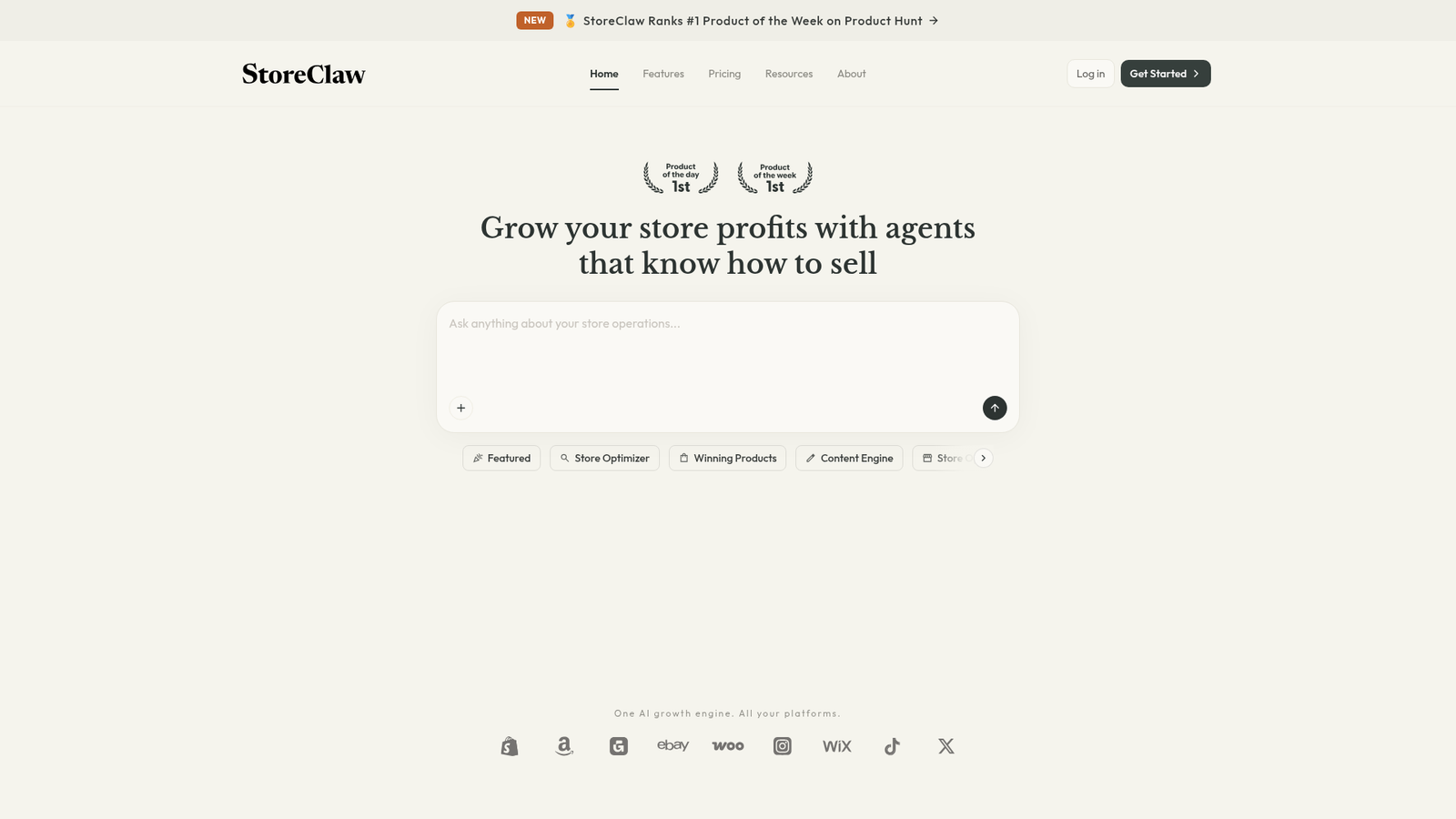
StoreClaw is an AI commerce platform built for online sellers, primarily those running Shopify or Amazon stores. The company describes it as an AI agent system — not just a dashboard or chatbot — that connects to your store, studies your business data, and then surfaces recommended actions it can carry out once you approve them. Their Product Hunt listing frames it as a platform where “agents know how to sell,” which suggests the emphasis is on decision-making and execution, not just data visualization. The target user is a solopreneur or small ecommerce team that’s managing too many tools and wants to consolidate into one workspace.
Key Features
Store Performance Analysis
StoreClaw ingests your sales figures, orders, inventory, and growth signals, then uses AI agents to study patterns over time. The idea is that it builds enough context to make useful, store-specific suggestions rather than generic advice.
Approval-Gated Execution
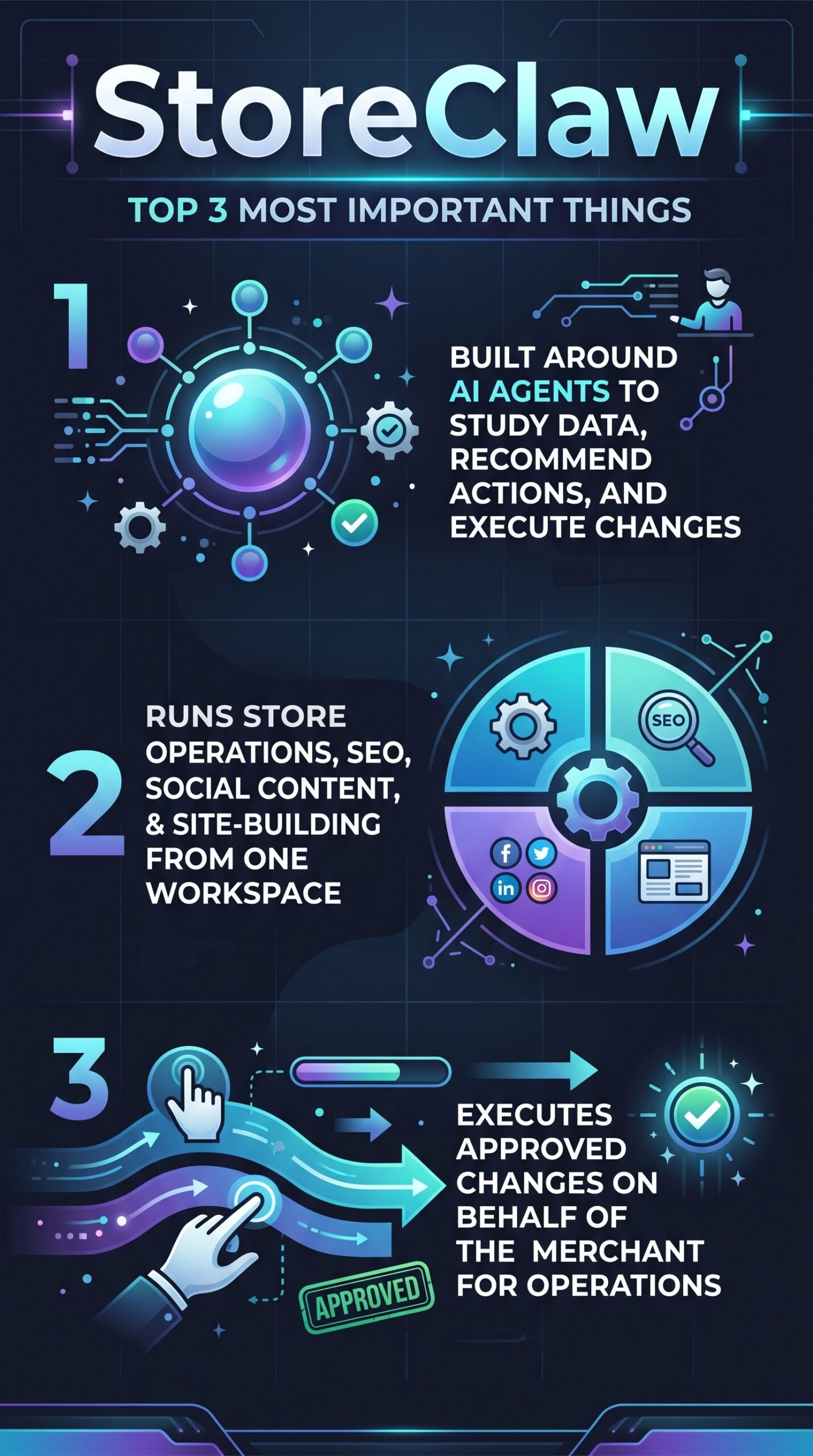
This is the most important design choice to understand. StoreClaw doesn’t act autonomously. The AI identifies opportunities and prepares actions — pricing updates, inventory adjustments, marketing campaign changes — but you authorize each one before it goes through. That human-in-the-loop structure makes sense for ecommerce, where a bad autonomous pricing change can cost you real money.
SEO and Social Content
Beyond operations, the platform includes tools for SEO and social content generation. The pricing page lists skills for “listing optimization, competitor analysis, SEO/GEO, social content generation, and ad ROI analysis” as pre-loaded in the Skill Hub. This gives it a marketing layer on top of the operational layer.
Multichannel Management
According to the vendor’s documentation, StoreClaw supports managing across multiple sales channels from one workspace, which matters if you’re selling on both Shopify and Amazon simultaneously.
Custom and Third-Party Skills
On paid plans, you can build your own custom Skills or install third-party ones. Each upload goes through a review for quality and security, according to the FAQ on the pricing page.
How StoreClaw Works
Connect and Ingest
You connect StoreClaw to your existing store using OAuth authorization. Their FAQ states that read-only permissions are requested by default, and write permissions are only granted when you explicitly configure an action. That’s a sensible security model.
Analyze and Recommend
Once connected, the AI agents study your store data and surface suggestions through a prompt-based interface. You can ask StoreClaw how your business is doing or request specific changes in plain language — it translates that into operational tasks.
Approve and Execute
You review the suggested actions and approve the ones you want to run. Nothing executes without your sign-off. This keeps you in control while still offloading the analysis and preparation work to the AI.
What the Evidence Shows
What the Vendor Claims
StoreClaw’s official materials describe a platform that reduces stress and effort for ecommerce operators by handling analysis, recommendations, and execution in one system. They claim it can monitor store health around the clock and handle tasks across operations, SEO, social content, and site building — with a free entry point and no credit card required. They also ranked as Product Hunt’s #1 Product of the Week, which signals some level of community traction.
What Users Report
Honestly, independent user reviews are thin. The available sources are mostly vendor marketing and launch-page language. There’s no substantial review corpus on G2, Capterra, or Trustpilot in the provided research data, and no detailed case studies or customer testimonials to draw from. What exists reads as promotional rather than validated. That’s not unusual for an early-stage product, but it does mean I can’t give you a reliable read on real-world satisfaction right now.
How It Stacks Up Against the Category
Most ecommerce AI tools pick one job. Klaviyo does lifecycle email. Triple Whale does attribution and analytics. Gorgias handles customer support. StoreClaw is trying to sit across all of those layers, which is ambitious. If it delivers, it’s genuinely useful for solo operators who can’t afford five separate tool subscriptions. If the execution is shallow, it’ll feel like a jack-of-all-trades that doesn’t outperform any single specialist. Right now there’s not enough evidence to say which it is.
StoreClaw vs Competitors
For context on how StoreClaw fits against the tools you might already be using, here’s a feature availability comparison. Note that this reflects documented features, not performance benchmarks. If you’re also evaluating AI tools for adjacent tasks, our Pagepilot review and Scaloom review cover related ecommerce optimization territory.
| Feature | StoreClaw | Shopify Magic | Klaviyo |
|---|---|---|---|
| AI-driven store ops automation | Yes | Partial | No |
| SEO and content creation | Yes | Partial | No |
| Email/lifecycle marketing | Partial | No | Yes |
| Multichannel management | Yes | No | Partial |
| Free plan available | Yes | Yes (bundled) | Yes (limited) |
| Starting paid price | $19.90/mo | Bundled w/ Shopify | $20+/mo |
Pricing
StoreClaw has four plans. The Free plan is forever free — no credit card required — and gives you 50 daily refresh credits with 1 concurrent task. The Pro plan is $19.90/month and includes 6,000 monthly credits plus 10 concurrent tasks. The Max plan runs $39.90/month with 12,000 monthly credits. The Ultra plan is $199.90/month for heavy users at 60,000 monthly credits. There’s also a yearly billing option that saves 20%, and a separate team or enterprise tier you can request directly. Every new account gets 300 free credits on signup.
You can review the full plan details at StoreClaw’s official website.
Pros and Cons
Pros
- Combines analytics, operations automation, SEO, and social content in one workspace — useful for solo operators who hate juggling tools
- Approval-gated execution means you stay in control of sensitive changes like pricing and inventory
- Genuinely free plan with no credit card required, making it low-risk to explore
- Pre-loaded Skill Hub covers store health, listing optimization, competitor analysis, and ad ROI out of the box
- Custom and third-party skill support on paid plans adds flexibility
Cons
- Very limited independent user reviews — it’s hard to verify the real-world performance claims with confidence
- The breadth of the feature set could mean shallower execution compared to specialist tools like Klaviyo for email or Triple Whale for attribution
- Credit-based billing can be hard to predict if your task volume varies month to month
Who Should Use StoreClaw?
StoreClaw looks like a good fit for solo ecommerce operators or small teams running Shopify or Amazon stores who are currently spread across multiple tools. If you’re paying for a separate SEO tool, a content generator, and an analytics dashboard, consolidating into one workspace at $19.90 to $39.90 a month could make financial sense — if the depth holds up.
It also suits merchants who want AI-assisted operations but aren’t ready to hand over the keys. The approval-gated design means cautious operators can benefit from the analysis without worrying about the AI making bad autonomous calls.
It’s probably not the right call if you’re already running a mature email program on Klaviyo or a well-configured attribution setup on Triple Whale. Those tools are deeper in their lanes. StoreClaw can’t realistically match their depth in lifecycle marketing or multi-touch attribution today. And if you’re a larger operation with dedicated teams for each function, the all-in-one approach may feel too lightweight. You can also check our Reppit AI review for another AI ecommerce tool comparison.
StoreClaw Main Facts
FAQ
Does StoreClaw work with Shopify and Amazon?
Yes. According to the vendor’s official site, StoreClaw supports both Shopify and Amazon, and positions both as free-start platforms where you can connect your store and begin exploring without a credit card.
Is my store data secure with StoreClaw?
Their FAQ states that all platform connections use industry-standard OAuth authorization, and read-only permissions are requested by default. Write permissions are only enabled when you explicitly configure an action. They also state they do not store raw API credentials.
What happens if I run out of credits?
According to their pricing FAQ, scheduled tasks pause until your next daily refresh or monthly reset — nothing breaks and nothing is lost. You can also buy add-on credits from your billing settings at any time.
Can I cancel without a penalty?
Yes. StoreClaw’s FAQ states you can cancel at any time with no fee or penalty, and your plan stays active until the end of the current billing period.
Final Verdict
StoreClaw is one of the more interesting early-stage ecommerce AI products I’ve come across in this research cycle. The agentic approach — where the AI doesn’t just report but prepares and executes approved actions — is genuinely different from most ecommerce tools. The pricing is accessible, the free plan is real, and the breadth of the Skill Hub is solid on paper.
The honest caveat is that “on paper” is doing a lot of work here. There’s no substantial body of independent reviews yet, and the feature set is ambitious enough that shallow execution in any one area would undermine the whole value of consolidating tools. If you’re on Shopify or Amazon and tired of fragmented tooling, the free plan is worth exploring. Just don’t cancel your specialist tools until you’ve actually seen StoreClaw deliver in your specific workflows.
Review Methodology
This review is based on analysis of StoreClaw’s official documentation, pricing pages, and feature set, combined with user signals and launch materials gathered from the vendor’s website, Product Hunt listing, and third-party ecommerce tool directories available at the time of writing.