
Disclosure: Some of the links on Daily Digital Reviews are affiliate links. This means that if you click on a link and make a purchase, we may earn a small commission — at no extra cost to you.
What Is MuleRun Trying to Solve?
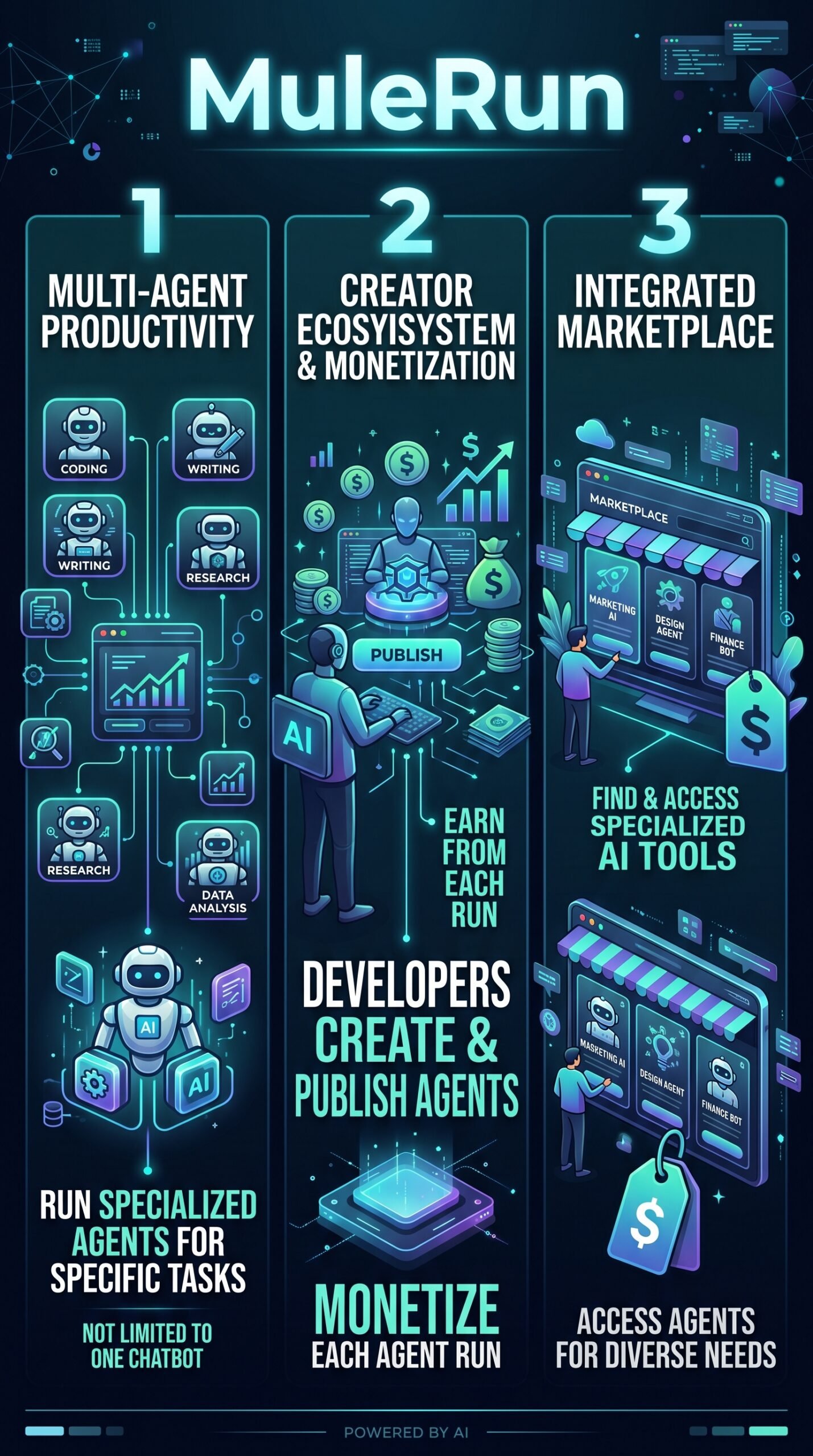
MuleRun is an AI agent marketplace and productivity platform — and that combination is what makes it interesting. Most AI tools give you one chatbot and ask you to make it work for everything. MuleRun takes a different approach: instead of one general assistant, you get access to a library of specialized agents, each built to handle a specific type of task. If you’ve ever felt like your AI tool is decent at writing but useless at research, or great at summarizing but can’t handle data analysis, that’s exactly the problem MuleRun fixes.
Quick Verdict: MuleRun has a genuinely smart concept — a marketplace of specialized AI agents combined with a creator ecosystem where developers can publish and monetize their work. The platform is backed by Alibaba, has clear pricing tiers, and covers a broad range of use cases. That said, independent user reviews are still thin, so real-world performance is hard to verify beyond demos and promotional material.
Overall Rating: 3.8 / 5 ⭐
Feature depth: 4.0/5 · Ease of use: 3.5/5 · Pricing value: 4.0/5 · Trust signals: 3.5/5

What Is MuleRun?
MuleRun describes itself as an “always-on AI workforce” — a platform where users can delegate multi-step tasks to specialized agents rather than typing prompts into a single general chatbot. According to their official site, the platform handles workflows across data analysis, content creation, email management, document processing, competitor research, social media scheduling, and more.
A South China Morning Post article links MuleRun to Alibaba Group Holding, describing it as initially launching as an AI agent marketplace before expanding into a broader AI productivity platform. That Alibaba connection gives it a different pedigree than most early-stage AI startups. The platform targets both end users who want to run agents and developers who want to build and sell them.
Key Features
AI Agent Marketplace
The core of MuleRun is its agent store. Rather than a single AI doing everything, you browse and run agents designed for specific tasks — think stock analysis, video generation, social media management, or coding assistance. The vendor’s materials describe agents covering research, finance, design, content, document handling, and web tasks like navigation and form filling.
Task Automation Across Categories
MuleRun handles multi-step workflows inside one system. The platform interprets your intent, breaks the job into steps, and executes them. A video review cited in the research characterizes it as a “super agent” platform that reduces context-switching — you stay in one place instead of moving between a research tool, a writing tool, and an analytics dashboard.
Creator Program and Monetization
This is where MuleRun stands out from nearly every competitor. Developers can build agents, submit them for approval, publish them to the marketplace, and earn revenue each time a user runs them. The platform provides underlying infrastructure including large models, MCP (Model Context Protocol), Pages, and payment processing. This is less common among AI tools and could attract a growing ecosystem of third-party builders over time — though that depends entirely on whether the user base grows enough to make it worthwhile for creators.
How MuleRun Works
For End Users
According to vendor documentation, the experience is chat-like. You describe what you want, the platform routes the task to an appropriate agent, and that agent performs multi-step work — web research, data visualization, form completion, or content drafting — without you needing to manage each step manually. You can run up to 10 tasks at once on the free plan, or unlimited parallel tasks on paid plans.
For Developers and Builders
Builders can create agents using MuleRun’s provided infrastructure, set a per-run price, and publish to the marketplace. The platform handles payment processing, distribution, and hosting. Think of it as an App Store model for AI agents — the platform takes care of the plumbing so creators can focus on building.
What the Evidence Shows
What the Vendor Claims
MuleRun pitches itself as a safer and easier path to agentic AI compared to assembling your own open-source agent stack. The South China Morning Post coverage frames it specifically as reducing privacy and security concerns that come with DIY agent setups. Their site lists an impressive range of supported task types and agent categories, and the creator program materials suggest an ambitious ecosystem vision.
What Users Report
Independent third-party review coverage is limited at this stage. Most available sentiment comes from community discussions, promotional content, and video demos rather than large datasets on platforms like G2 or Trustpilot. The general impression is positive — users appear interested in the concept and the breadth of use cases — but there’s not enough volume of independent feedback to draw strong conclusions about reliability, output quality, or support responsiveness. This is worth keeping in mind if you’re considering a paid plan.
How It Stacks Up Against the Category
Most AI productivity tools are closed ecosystems with fixed features. MuleRun’s marketplace model is a meaningful structural difference. Agent.ai takes a similar directory approach, and MindStudio allows no-code agent creation, but MuleRun attempts to combine discovery, execution, and creator monetization in one product. That’s a broader bet than most competitors are making, which is either a strength or a risk depending on execution.
MuleRun vs Competitors
For context on how MuleRun fits the broader landscape, you might also want to read the HeyBoss AI review or the Mujo AI review for comparison with other AI productivity tools.
| Feature | MuleRun | Agent.ai | MindStudio |
|---|---|---|---|
| Agent marketplace | Yes | Yes | Partial |
| Creator monetization | Yes (per-run) | No | Partial |
| Multi-step task execution | Yes | Partial | Yes |
| Personal VM included | Yes (paid plans) | No | No |
| Free plan available | Yes | Yes | Yes |
| Starting price (paid) | $16/month | Varies | Varies |
Pricing
MuleRun’s pricing is more transparent than the research initially suggested. There’s a free tier at $0 that includes 500 bonus credits on sign-up and 200 daily refreshing credits. Paid plans start at $16/month (Plus) with 2,000 monthly credits, $32/month (Super) with 4,500 credits, and $160/month (Pro) with 23,000 credits. Yearly billing cuts 20% off each tier. Credits convert at $1 = 100 credits, and you can top up on paid plans. Team and Enterprise plans are also available. For current details, check the MuleRun pricing page directly.
Pros and Cons
Pros
- Broad task coverage across research, content, data analysis, email, and automation in one platform
- Marketplace model means you’re not locked into a single AI’s capabilities — you can pick the right agent for each job
- Creator monetization model could drive a growing ecosystem of specialized, high-quality agents
- Free plan with daily credit refresh makes it accessible without commitment
- Alibaba backing suggests stronger infrastructure and longer runway than a typical early-stage startup
Cons
- Independent third-party reviews are sparse — hard to verify real-world reliability beyond demos
- Output quality likely varies depending on the specific agent and how well it was built by its creator
- The platform is still maturing — capability claims are largely promotional at this stage
Who Should Use MuleRun?
MuleRun is a strong fit for solopreneurs and small teams who need to automate multiple different types of work — not just one thing. If you’re doing research, drafting content, analyzing data, and managing documents, and you’re tired of stitching together five separate tools, the “one platform, many agents” model makes real sense.
Developers interested in building and monetizing AI agents will also find this worth exploring — especially given the per-run revenue model and built-in payment infrastructure. That’s a more direct monetization path than most platforms offer.
It’s probably not the right pick if you only need one specific type of AI help — a dedicated writing tool or SEO tool will likely outperform a generalist marketplace agent for a narrow use case. And if you need proven enterprise reliability with documented SLAs, the platform isn’t mature enough yet to make that case confidently. You might also want to compare it with other AI tools we’ve reviewed, like the Kraflio review, to see how different approaches stack up.
MuleRun Main Facts
Frequently Asked Questions
Is MuleRun free to use?
Yes. MuleRun has a free plan that includes 500 bonus credits on sign-up and 200 credits refreshed every day. It supports up to 10 concurrent tasks and 5 deployable pages, with 10 GB of drive storage. No credit card is required to get started based on the current pricing page.
Who built MuleRun?
According to South China Morning Post reporting, MuleRun was developed by Alibaba Group Holding. It launched as an AI agent marketplace and has since expanded into a broader AI productivity platform.
Can developers make money on MuleRun?
Yes. MuleRun includes a creator program that lets developers build agents, set a per-run price, and earn revenue when users run their agents. The platform provides infrastructure including large models, MCP, Pages, and payment processing.
How does the credit system work?
MuleRun uses a credits-based system where $1 equals 100 credits. Free users get 200 credits daily. Paid plans include monthly credit allowances (2,000 on Plus up to 23,000 on Pro) and the ability to top up credits as needed.
Final Verdict
MuleRun is one of the more interesting AI platforms to emerge recently, mainly because of its structure. A marketplace of specialized agents with a built-in creator economy is a different bet than most competitors are making — and the Alibaba connection gives it more credibility than a typical early-stage product.
The pricing is clear and the free plan is genuinely usable. The main unknown is quality at the agent level. Because the marketplace depends on third-party builders, output consistency will vary. If you’re a solopreneur who needs to automate diverse workflows and wants a single system rather than a stack of separate tools, MuleRun is worth testing on the free tier. If the agents hold up in your specific use case, the paid plans are reasonably priced for what they offer.
Review Methodology
This review is based on analysis of MuleRun’s official documentation, pricing pages, and feature set, combined with vendor positioning materials, South China Morning Post reporting on Alibaba’s AI products, community and creator program content, and available video demonstrations of the platform in use.