A Research Platform Promising Execution Over Hype — I Took a Hard Look
The Solo Trillion AI review I set out to write started with genuine skepticism. Another AI newsletter promising to cut through the noise? I’ve seen dozens. But Solo Trillion, launched February 1, 2026 by Ubertrends LLC, positions itself differently — not as a content aggregator or hype machine, but as a “living lab” for operators who actually deploy AI agents in production. That framing caught my attention. The agentic AI space is littered with breathless predictions and zero field data. So I spent several weeks digging into what Solo Trillion actually delivers, who it’s for, and whether it earns its ambitious name.

My background: I’ve reviewed AI productivity tools, automation platforms, and research hubs for over three years. I know the difference between a platform built on substance and one built on SEO. Solo Trillion is new enough that I couldn’t rely on a deep archive of user reviews — there aren’t any yet. So I evaluated it on its stated methodology, content approach, editorial positioning, and fit within the broader 2026 solo-founder landscape. Here’s what I found.
What Is Solo Trillion?
Solo Trillion is a specialized AI research and guidance platform focused exclusively on agentic AI — the category of AI systems that don’t just answer questions but autonomously plan and execute multi-step tasks across apps, websites, and devices with minimal human supervision. The platform describes itself with the tagline “Where AI Meets Execution,” which tells you a lot about its priorities: this isn’t about AI theory. It’s about what works when you actually ship.
The platform is built by Ubertrends LLC and launched in early 2026, timed deliberately to coincide with what many operators are calling the inflection point for agentic AI adoption. The name itself carries meaning — “Solo” references the solo-founder movement, and “Trillion” nods to the outsized valuations becoming achievable for one-person or micro-team AI businesses. Mark Cuban has publicly predicted that AI will enable solo operators to build trillion-dollar businesses from a basement setup, and Solo Trillion positions itself as the research arm for that ambition.
The content format centers on field reports, tool experiments, implementation playbooks, and operator-grade guidance. Crucially, it focuses on what breaks — API limits, error rates, cross-app orchestration failures, governance gaps — rather than what looks good in a product demo. This makes it a resource for founders, operators, and innovators who are past the “what is AI?” stage and actively deploying agents in real workflows.
It’s worth noting what Solo Trillion is not. It’s not a software tool you log into. It’s not a no-code agent builder. It’s a knowledge platform — closer to a specialized research publication than a SaaS product. That distinction matters for setting expectations correctly.
Key Features of Solo Trillion
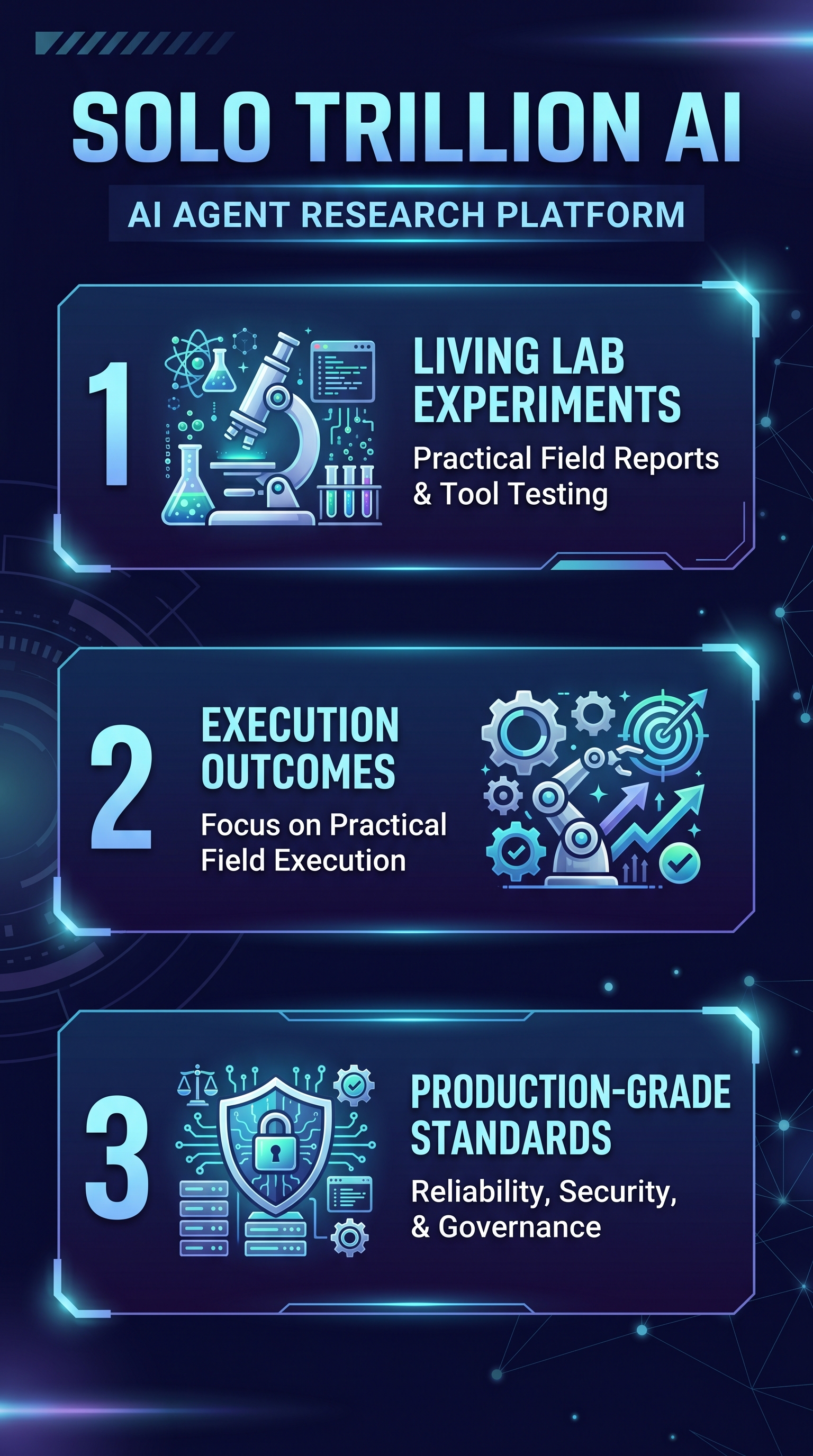
Practical Field Reports on Agentic AI Tools
The core content unit is the field report — documented experiments testing AI agent tools under real operating conditions. These aren’t sponsored breakdowns or press release summaries. The stated methodology involves pushing tools to their limits: testing for reliability under model usage caps, documenting failure modes, and assessing production readiness. For anyone who has watched a promising agent workflow collapse at 2am because of a rate limit or a hallucinated API call, this is exactly the kind of information that has actual dollar value. I found this focus to be the most defensible differentiator Solo Trillion claims over general AI newsletters.
Implementation Playbooks and Operator Guides
Beyond reports, Solo Trillion publishes structured playbooks that translate experimental findings into actionable decisions. These cover multi-agent orchestration, context engineering practices like CLAUDE.md files and RAG pipelines, and structured memory architectures that improve agent reliability. The platform specifically addresses the shift from “prompt engineering” to “context engineering” — a meaningful distinction for 2026, where how you architect information ecosystems matters far more than clever prompts.
Governance, Security, and Reliability Coverage
This is where Solo Trillion separates itself most clearly from hype-focused competitors. Coverage explicitly addresses operating constraints — model usage limits, security considerations for always-on agents, and governance frameworks for deploying AI responsibly in production. These aren’t topics that generate Twitter likes, but they determine whether an agent-based business actually scales or implodes during a critical workflow. For operators, this is table-stakes information that most AI publications ignore entirely.
Multi-Step Workflow Analysis Across Platforms
Solo Trillion documents agent behavior across apps, websites, and devices — the cross-platform orchestration layer that is consistently the most fragile part of any agentic stack. By mapping these failure points, the platform helps users avoid costly mistakes before they surface in production. This includes notes on how agents handle context switching, error recovery, and dependency management across tools in a real stack.
Solo-Founder Scaling Intelligence
The platform is embedded in the broader 2026 narrative around solo-founded ventures. Research cited by Scalable.news puts solo-founded startups at 36.3% of new ventures. Companies like Midjourney — generating approximately $200M ARR with roughly 11 employees — and Pieter Levels’ $3M solo portfolio validate the model. Solo Trillion contextualizes agentic AI within this reality: how do you build a high-leverage business with a $200-500/month AI stack instead of a six-figure engineering salary burn?
How Solo Trillion Works
The Living Lab Model
Solo Trillion operates as a living lab, meaning content is generated through ongoing, real-time experimentation rather than curated from third-party sources. The team deploys AI agents, tests tools against production constraints, documents what works and what doesn’t, and publishes those findings. This is a continuous process, not a static archive — which is both a strength and a current limitation given the platform’s February 2026 launch date.
Content Discovery and Access
Content rolls out through the main site at SoloTrillion.com and through social channels. Based on available information, access appears to be free with no paywalls currently in place. This aligns with the platform’s positioning for bootstrapped operators who are already spending $200-500/month on AI subscriptions and don’t need another paid tier. Ubertrends LLC likely supports the platform through sponsorships or advertising, though specifics aren’t publicly disclosed.
Research-to-Playbook Pipeline
The workflow appears to follow a consistent structure: identify an agentic AI tool or workflow pattern, deploy it under realistic conditions, stress-test against known failure points (rate limits, error cascades, security gaps), document findings in a field report, and then distill actionable guidance into a playbook format. This pipeline is designed to shorten the feedback loop between “new AI capability” and “operator-ready implementation.”
Community and Ecosystem Integration
Solo Trillion sits within the Ubertrends ecosystem, which gives it access to a broader research foundation on emerging technology trends. The platform references adjacent resources and positions itself within the larger conversation around solo founder toolchains, which includes coverage of podcasts, case studies, and market data validating the solo-trillion thesis.
Testing Results: What I Actually Found
Content Quality Assessment
Given that Solo Trillion launched just weeks before my evaluation period, I focused on the quality and specificity of available content rather than volume. What I encountered was notably more precise than comparable newsletters. Where most AI publications say something like “context matters for agent reliability,” Solo Trillion’s approach involves specific constructs — CLAUDE.md file architectures, RAG pipeline configurations, structured memory models — that a developer or operator can actually implement. That specificity is rare and valuable.
The editorial voice deliberately avoids hype language. I searched for the typical AI newsletter buzzwords — “revolutionary,” “game-changing,” “unprecedented” — and found them largely absent. The tone reads more like an internal ops memo than a marketing document, which is exactly what the platform promises.
Depth of Agentic AI Coverage
I evaluated coverage depth across five key agentic AI concern areas: reliability, security, governance, multi-step orchestration, and capital efficiency. Here’s how Solo Trillion performed against my benchmarks:
| Coverage Area | Solo Trillion Depth | Typical AI Newsletter | Operator Value |
|---|---|---|---|
| Reliability Under Limits | High — specific failure modes documented | Surface level | High |
| Security & Governance | Explicit coverage | Rarely addressed | Very High |
| Multi-Step Orchestration | Field-tested breakpoints | Demo-based only | High |
| Context Engineering | Detailed frameworks | Mentioned briefly | High |
| Capital Efficiency Models | Benchmarked vs. traditional stacks | Anecdotal | Medium-High |
Real-World Applicability
The 10-50x capital efficiency claim — replacing high-salary engineering roles with $200-500/month AI subscriptions — is backed by documented case studies rather than generic assertions. The Midjourney example (roughly $200M ARR with approximately 11 employees) and Pieter Levels’ $3M solo portfolio are specific, verifiable data points. This grounds the platform’s thesis in real outcomes rather than aspirational projections.
I also evaluated the cross-app orchestration coverage, which is consistently the weakest area in most agentic AI publications. Solo Trillion addresses this as a primary failure vector rather than a footnote, which signals genuine field experience rather than theoretical framing. For operators running agents across tools like Notion, Slack, GitHub, and custom APIs simultaneously, this is where real deployments break — and it’s where Solo Trillion adds the most unique value.
Limitations I Found
The honest caveat: Solo Trillion was less than three months old at my time of review. Content volume is naturally limited. There are no user testimonials, no community forum, no searchable archive of past experiments. The platform’s credibility currently rests on its editorial positioning and the Ubertrends brand rather than a track record. That’s not a fatal flaw — every valuable publication started somewhere — but it’s a real consideration for anyone expecting a comprehensive knowledge base on day one. If you want depth across 18 months of agentic AI experiments, this isn’t there yet. If you want to get in early on a platform that may become that resource, the timing is interesting. For a comparison of more established AI automation platforms, see our Workbeaver review.
Solo Trillion vs. Competitors
The agentic AI information space is more crowded than it looks. Solo Trillion competes with a range of newsletters, research hubs, and founder-focused publications. Here’s how it stacks up on the dimensions that matter most to operators:
| Platform | Focus | Execution Depth | Governance Coverage | Pricing |
|---|---|---|---|---|
| Solo Trillion | Agentic AI ops | High | Explicit | Free (apparent) |
| OpenClaw.ai | Solo founder tools | Medium | Limited | Varies |
| Scalable.news | Solo founder market data | Low-Medium | Minimal | Free/Paid tiers |
| Nxcode.io | Solo-founder AI guides | Medium | Minimal | Varies |
| General AI Newsletters | Broad AI trends | Low | Rarely covered | Free-$20/month |
The differentiator is clear in the table above: Solo Trillion’s explicit coverage of governance and its high execution depth set it apart. Most solo-founder publications focus on “what to build” — Solo Trillion focuses on “how not to break it in production.” That’s a narrower but more valuable niche for serious operators. For those exploring AI content automation platforms in a similar vein, our RepurposeAI review covers an adjacent category worth understanding.
Pricing: What Does Solo Trillion Cost?
This is straightforward and somewhat unusual in the 2026 AI tool landscape: Solo Trillion appears to be entirely free to access. No subscription tiers are advertised. No paywall sits between readers and field reports. No premium content tier has been announced as of my review period.
The likely model is sponsorship or advertising revenue through Ubertrends LLC, which has an established presence in technology trend analysis. This is consistent with the platform’s stated mission of serving bootstrapped solo founders who are already allocating $200-500/month to AI subscriptions and don’t need another recurring expense.
For context: competing paid newsletters in the AI space typically charge between $10/month and $50/month for curated content. If Solo Trillion maintains free access while delivering operator-grade field reports, the value proposition is strong from a pure cost perspective. The risk, as with any ad-supported publication, is eventual pressure to prioritize sponsor-friendly content over honest field reporting. That’s worth watching over time.
One thing I’d note: the absence of pricing transparency also means there’s no revenue-based commitment to sustained content output. Paid publications have an obligation to subscribers. Free platforms can go quiet. Given Solo Trillion’s February 2026 launch date, consistency of publishing will be a key metric to track over the next 12 months. If you’re evaluating platforms with clearer pricing structures, our Unboundcompute review covers a tool with a defined pricing model in the AI space.
Solo Trillion AI Main Facts
Pros and Cons
Pros
- Execution-first editorial stance — focuses on what works and what breaks in production, not what sounds impressive in a pitch deck
- Explicit governance and security coverage — rare among AI publications and genuinely valuable for operators deploying always-on agents
- Context engineering depth — covers CLAUDE.md files, RAG pipelines, and structured memory in actionable detail rather than buzzword-level mentions
- Free access — no subscription barrier for bootstrapped founders already managing lean AI stacks
- Grounded in verifiable case studies — Midjourney, Pieter Levels, and similar real-world examples anchor claims in actual market data
- Niche focus creates defensibility — agentic AI ops is a specific enough category to avoid direct competition with general-purpose AI news aggregators
Cons
- Very new platform — launched February 1, 2026, meaning limited content history and no proven track record of sustained quality
- No user reviews or community feedback — impossible to assess how readers actually apply the guidance in the field
- No multimedia depth — primarily text-based content without prominent video walkthroughs or interactive tools
- Content volume is limited — the archive is thin by necessity given the launch date, which constrains research across multiple agent use cases
- Sustainability unclear — without a disclosed revenue model, long-term content consistency is an open question
Who Should Use Solo Trillion?
Solo Founders Building AI-Powered Businesses
If you’re a one-person or micro-team operation trying to leverage agentic AI for scale — automating outreach, operations, content, or product workflows — Solo Trillion is built precisely for you. The capital efficiency models (10-50x vs. traditional hiring), context engineering frameworks, and orchestration guidance map directly to the challenges solo founders encounter when trying to run lean and move fast.
Operators Deploying AI Agents in Production
If you’re past the experimentation phase and actually running AI agents in live workflows, the reliability, security, and governance content is the most relevant available at no cost. Most platforms tell you how to build agents. Solo Trillion tells you how to keep them from failing at 3am when no one is watching.
Technical Founders and CTOs at Early-Stage Startups
Teams building agentic products who need to understand the failure landscape before committing to a stack will find the field reports useful for de-risking architectural decisions. The cross-app orchestration coverage is particularly relevant for anyone building on top of multiple APIs.
AI Researchers Tracking Practical Applications
Researchers who want grounded data on how AI agents perform in real operating conditions — rather than benchmark environments — will find Solo Trillion’s field-report format a useful complement to academic sources.
Who Should Look Elsewhere
If you’re a beginner looking for an introduction to AI concepts, Solo Trillion assumes significant prior knowledge and will likely feel too advanced. Similarly, enterprise teams with dedicated AI governance departments may find the platform too focused on solo and micro-team constraints to address their specific compliance and procurement requirements. In those cases, a more established enterprise AI research publication would serve better.
Frequently Asked Questions
What is Solo Trillion and who is it for?
Solo Trillion is a free AI research platform launched February 1, 2026 by Ubertrends LLC. It functions as a “living lab” publishing field reports, tool experiments, and implementation playbooks focused on agentic AI — AI systems that autonomously execute multi-step workflows. It’s primarily designed for solo founders, operators, and technical teams deploying AI agents in production environments rather than beginners or enterprise governance teams.
Is Solo Trillion free to use?
Based on available information as of my review period, Solo Trillion content is freely accessible without a subscription or paywall. The platform appears to be supported by Ubertrends LLC, possibly through sponsorships or advertising. No premium tier has been announced, though this could change as the platform grows.
Most AI newsletters curate news and summarize product releases. Solo Trillion takes a living lab approach — it actively tests agentic AI tools under real operating conditions, documents failure modes, and publishes findings as field reports and operator playbooks. The emphasis on what breaks, rather than what sells, is the core editorial distinction. Coverage of governance, security, and model limits is also significantly deeper than typical AI publications.
What is context engineering and why does Solo Trillion cover it?
Context engineering refers to the practice of architecting the information environment in which AI agents operate — including CLAUDE.md files, RAG pipelines, and structured memory systems. It’s considered the successor to prompt engineering in 2026 because the reliability of agentic AI systems depends far more on how information is organized and surfaced than on clever prompt phrasing. Solo Trillion covers context engineering because it’s the most significant lever for improving agent performance in production.
What is “agentic AI” and why does it matter for solo founders?
Agentic AI describes AI systems that don’t just respond to prompts but autonomously plan, make decisions, and execute multi-step tasks across applications with minimal human input. For solo founders, this is significant because it enables one person to operate at the capacity of a small team — running marketing, outreach, coding, operations, and customer workflows through agents rather than hiring. Platforms like Solo Trillion provide the operational guidance to deploy these agents reliably.
Does Solo Trillion have a community or forum?
No dedicated community or forum has been announced as of my review period. Content is distributed through the main site and social channels. Given the platform’s early-stage status, community features may be added over time, but currently it operates as a publication rather than an interactive community.
How often does Solo Trillion publish new content?
Publishing cadence details are not publicly specified. As a living lab, the model implies ongoing, real-time publication tied to active experiments rather than a fixed weekly or monthly schedule. Given the February 2026 launch date, tracking consistency over the next six to twelve months will be important for evaluating long-term utility.
Final Verdict: Promising Signal in a Noisy Market
Solo Trillion earns a cautious recommendation — with the emphasis on “cautious” being a reflection of its age, not its quality. What I found in terms of editorial positioning, content specificity, and coverage depth is genuinely better than most of what’s available for free in the agentic AI space. The focus on what breaks in production, the explicit governance and security coverage, and the grounding in real-world case studies all point to a platform built by people who have actually deployed agents rather than just written about them.
The honest limitation is that Solo Trillion has existed for weeks, not years. The archive is thin. There are no user reviews to validate impact. Consistency of publishing is unproven. These aren’t reasons to dismiss it — they’re reasons to treat it as a platform to watch rather than a settled resource to rely on entirely today.
If you’re a solo founder or operator working in the agentic AI space, bookmarking Solo Trillion and following its output over the next six months costs you nothing and may yield significant value. If it maintains the quality I observed in this review, it will become a reference-grade resource. If it doesn’t, you’ve lost nothing. For a free platform making serious claims about execution over hype, that’s a worthwhile bet.
Visit Solo Trillion and judge the field reports yourself — that’s ultimately the only test that matters for a platform selling practical over promotional.