Disclosure: Some of the links on Daily Digital Reviews are affiliate links. This means that if you click on a link and make a purchase, we may earn a small commission — at no extra cost to you.
SEO Is Changing Fast — Does Keytomic Keep Up?
This Keytomic review looks at one of the newer AI SEO platforms trying to solve a problem most marketers are just starting to feel: ranking in Google is no longer enough. You also need to show up in ChatGPT, Gemini, Perplexity, and other AI answer engines that are eating into traditional search traffic.
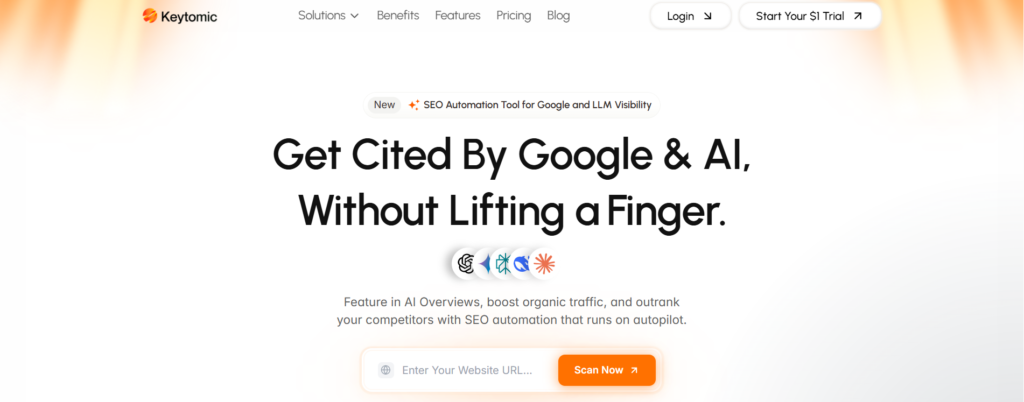
Keytomic pitches itself as the tool that handles both — from keyword research all the way to auto-publishing and AI citation tracking. That’s a big promise. I analyzed the vendor’s documentation, pricing pages, and available user reports to see how much of it holds up.
Quick Verdict: Keytomic offers a genuinely broad feature set that covers keyword research, AI content generation, auto-publishing, backlink sourcing, and AI visibility tracking — all in one plan.
Overall Rating: 3.6 / 5 ⭐
Feature depth: 4/5 · Ease of use: 3.5/5 · Pricing value: 3.5/5 · Trust signals: 3.5/5
What Is Keytomic?
Keytomic is an AI SEO and content automation platform built for founders, marketers, and small teams who want to put their SEO workflow on autopilot. It’s positioned as an all-in-one replacement for multiple disconnected tools — keyword research, content writing, scheduling, publishing, and ranking analytics — wrapped into a single pipeline.
The key differentiator, according to their site, is that it’s built for both traditional search and AI answer engines. Most SEO tools still focus purely on Google rankings. Keytomic claims to go further by helping content surface in AI Overviews, ChatGPT responses, Gemini answers, and Perplexity citations. They describe this as “GEO visibility” — generative engine optimization — which is a real and growing concern for brands as AI-powered search takes a larger share of user attention.
Their site claims 1,272+ users are currently on the platform and mentions that it covers 50+ industries. It’s designed to require minimal SEO knowledge, with a stated setup time of around 2 minutes and a claim that the full SEO workflow can be up and running in under 25 minutes.
Key Features
AI Keyword Research
Keytomic’s keyword engine is built to find high-intent, low-competition queries automatically based on your niche. Rather than manually building keyword lists, the system scans your site, niche, and competitors to map out opportunities. The focus is on rankable keywords — terms you can realistically compete for — rather than vanity metrics.
30-Day Content Calendar
Once keywords are identified, the platform builds a 30-day rolling content calendar. Users review and approve the plan, then the system takes over. According to the vendor, up to 30 SEO articles can be generated and published monthly, with automated publishing of up to 10 blogs per day. The calendar can hold up to 60 topics at a time.
Auto-Publishing to CMS
Keytomic integrates directly with WordPress, Shopify, Webflow, Wix, Framer, Ghost, Joomla, and Sanity — 12+ CMS platforms in total. Content can go from draft to published without manual export or copy-paste. Auto-indexing is also included to help new articles get picked up by search engines faster.
AI Visibility Tracking
This is the feature that separates Keytomic from most traditional content tools. The platform tracks how often your brand or domain gets cited or mentioned in AI-generated answers across major LLMs. Their site claims an “82.27% first page AI citations” rate, though this figure comes directly from Keytomic’s own marketing materials and hasn’t been independently verified.
Backlinks and Reddit AI Agent
The plan includes 30 high-DR backlink opportunities per month (valued at over $800/month according to their site). There’s also a Reddit AI Agent that finds relevant threads in your niche, drafts on-brand replies, and aims to build visibility and referral traffic through community engagement.
E-E-A-T Content and Schema
Generated content is described as following Google’s E-E-A-T guidelines (experience, expertise, authoritativeness, trustworthiness) with built-in structure for LLM readability. FAQ schema generation is included, which supports eligibility for rich snippets and structured answer formats in search.
How Keytomic Works
Step 1: Site Scan and Setup
According to their documentation, you start by submitting your website URL and connecting your CMS. The AI agent scans your site, analyzes your niche, and maps competitor keyword gaps to identify your best opportunities. This is meant to take around 2 minutes.
Step 2: Review Your Content Plan
The system generates a 30-day content calendar based on the scan. You review the proposed topics and article schedule, make any adjustments, and approve the plan. The vendor says users typically spend around one session per week on this review step.
Step 3: Auto-Publish and Track
Once approved, Keytomic drafts articles, attaches custom images, adds metadata and schema, and publishes directly to your CMS on schedule. The platform then monitors search rankings and AI citation data, giving you visibility into how your content is performing across both traditional and AI-powered search surfaces.
What the Evidence Shows
What the Vendor Claims
Keytomic describes itself as replacing a $2,500+ monthly SEO toolkit for $99/month. Their site highlights 36,000 hours saved across users, 12,000+ articles generated, and an 82.27% first-page AI citation rate. They also promote a 95% cost saving versus agency or multi-tool setups. These numbers come entirely from Keytomic’s own marketing materials and should be treated as self-reported claims until independent data confirms them.
What Users Report
The testimonials on their website — from users like a Head of Content, a Digital Growth VP, and a CMO — generally describe the platform as a time saver that reduces the manual burden of content operations. One beta tester, identified as a Content Director, mentioned mid-tail keywords climbing 30 places during a 90-day beta test, while also noting “it’s not perfect.” Another user described going from a week of content management work to “clicks-to-publish in under an hour.”
These testimonials are hosted on the vendor’s own site, so they carry the usual caveats. More importantly, Capterra currently shows zero independent user reviews for Keytomic, and there’s no meaningful review volume on other third-party platforms from what’s available in public research. That’s a real limitation when assessing whether the platform delivers consistently across different use cases and team sizes.
How It Stacks Up Against the Category
Most established SEO content tools — Surfer, Clearscope, MarketMuse — focus on content optimization within a writing workflow. They help you improve a draft, not generate and publish one end-to-end. Frase and Scalenut move a bit closer to full-pipeline tools, but neither claims to track AI citation visibility across LLMs. Keytomic’s combination of auto-publishing, backlink sourcing, Reddit automation, and AI visibility measurement is genuinely broader than what most direct competitors offer. Whether that breadth translates into depth is still an open question given the limited external validation.
Keytomic vs Competitors
If you’re weighing Keytomic against established tools, here’s how the feature availability compares. For a deeper look at similar platforms, see our RankPilot review and our Kraflio review.
| Feature | Keytomic | Surfer SEO | Frase |
|---|---|---|---|
| AI content generation | Yes | Yes (via Surfer AI) | Yes |
| Auto-publishing to CMS | Yes (12+ platforms) | Partial (WordPress) | No |
| AI answer engine tracking | Yes | No | No |
| Backlink sourcing | Yes (30/month included) | No | No |
| 30-day content calendar | Yes | No | Partial |
| Starting price | $99/month | ~$89/month | ~$45/month |
Pricing
Keytomic runs a single flat-rate plan currently listed at $99 per month (or less on the annual plan with a 20% discount). The pricing page shows this as an “All-in-One” plan that includes everything: 30 SEO articles per month, up to 3 organization seats, bi-weekly technical SEO audits, 30 high-DR backlink opportunities, CMS integrations, auto-indexing, the Reddit AI Agent, and multilingual content in 150+ languages.
There’s a $1 trial offer listed on the site for 3 days, and a 14-day money-back guarantee if you’re not satisfied. The pricing page also notes a 10% discount on every additional project added to your organization account, which suggests a path for agencies or multi-brand users to scale down costs. Higher-tier or enterprise pricing isn’t publicly listed in the available sources.
For current details, visit Keytomic’s official website.
Pros and Cons
Pros
- End-to-end automation: Covers keyword research, content creation, publishing, backlinking, and AI visibility tracking in one platform — reducing the need to juggle multiple tools.
- AI answer engine focus: One of the few tools actively tracking brand citations across ChatGPT, Gemini, Perplexity, and Claude — a genuinely forward-looking capability.
- Broad CMS support: Direct publishing integrations with 12+ platforms including WordPress, Shopify, Webflow, and Framer keeps the workflow tight.
- Reasonable entry price: At $99/month with backlinks, auto-publishing, and a content calendar included, the value-per-feature ratio looks strong on paper compared to buying these capabilities separately.
- Low barrier to entry: The vendor’s stated 2-minute setup and no-SEO-knowledge-required positioning makes it accessible for non-technical teams.
Cons
- Nearly zero independent reviews: Capterra shows no user reviews, and third-party validation is minimal. That makes it hard to judge real-world reliability or output quality with confidence.
- Self-reported performance metrics: The 82.27% AI citation rate and other headline stats come from Keytomic’s own marketing, not third-party audits.
- Enterprise features unclear: Collaboration controls, editorial governance, and analytics depth for larger teams aren’t clearly documented in public sources.
Who Should Use Keytomic?
Solopreneurs and small teams who want to publish content consistently without a dedicated SEO hire will find the automation genuinely useful. If you’re currently using three or four different tools to manage keywords, writing, and publishing, consolidating into one platform at $99/month makes sense to explore.
Founders building a content moat will appreciate the 30-day calendar and auto-publishing. You approve once, the pipeline runs. That’s a real time save if your bottleneck is execution, not strategy.
Brands investing in AI search visibility — especially those in competitive B2B or SaaS niches where AI Overviews and LLM citations are becoming a traffic source — are exactly who Keytomic is designed for.
On the other hand, enterprise marketing teams with strict editorial controls, approval workflows, and compliance requirements will likely find the feature set too lean and the review evidence too thin to justify adoption without extensive piloting. Similarly, SEO professionals who want granular keyword data, deep SERP analysis, or advanced rank tracking may find tools like Surfer or MarketMuse more precise for that specific need. You can compare options in our SaasNiche review for more context on the AI content tool landscape.
Frequently Asked Questions
What does Keytomic actually do?
Keytomic is an AI SEO platform that handles keyword research, article writing, content scheduling, CMS publishing, backlink sourcing, and brand visibility tracking across both Google and AI answer engines like ChatGPT and Gemini — all from one dashboard.
How much does Keytomic cost?
The publicly listed price is $99 per month for the all-in-one plan, with a 20% discount on annual billing. A $1 three-day trial and a 14-day money-back guarantee are both offered according to the pricing page.
Does Keytomic help you rank in AI Overviews and ChatGPT?
That’s a core part of their pitch. The platform generates E-E-A-T-structured content with FAQ schema and tracks how often your brand gets cited in AI-generated responses. The company positions this capability as “GEO visibility” — generative engine optimization.
Is Keytomic suitable for beginners?
According to the vendor’s documentation, no SEO experience is required. The setup process is designed to take around 2 minutes and the workflow is built around approving AI-generated plans rather than building them manually from scratch.
How many articles does Keytomic generate per month?
The all-in-one plan includes up to 30 SEO articles generated and published per month, with a capacity of up to 10 blog posts published per day and up to 60 topics stored in the content calendar at any time.
Final Verdict
Keytomic is one of the more ambitious AI SEO tools to come out in this cycle. The feature set is broad — keyword research, content generation, auto-publishing, backlinks, Reddit automation, and AI citation tracking — and the $99/month price point makes it genuinely accessible for small teams. If even half of what the platform claims holds up in practice, it would represent solid value compared to buying those capabilities across multiple tools.
The honest caveat is that independent review data is close to nonexistent right now. The testimonials on their site are encouraging but unverified by third parties. For a platform making bold claims about AI visibility and citation rates, that gap matters. The $1 trial lowers the risk of finding out for yourself, and the 14-day money-back guarantee gives you a reasonable runway to test output quality before committing. Go in with realistic expectations, run a real content test, and judge from what you see.
Review Methodology
This review is based on analysis of Keytomic’s official website, pricing pages, and feature documentation, combined with user sentiment gathered from Capterra listings and on-site testimonials. Competitor feature comparisons are drawn from publicly available product pages for Surfer, Frase, and related tools. No hands-on testing was conducted. Where independent review data was absent, that limitation is noted explicitly rather than filled with assumptions.