Disclosure: Some of the links on Daily Digital Reviews are affiliate links. This means that if you click on a link and make a purchase, we may earn a small commission — at no extra cost to you.
SEO Tools Are Broken. Can RankPilot Fix That?
The RankPilot review question a lot of solopreneurs are asking right now is simple: do we really need another SEO tool, or is this one actually different? Most SEO platforms hand you a pile of data and leave you to figure out what to do with it. You end up juggling three or four tools just to go from keyword research to a published article.
RankPilot’s pitch is that it replaces that messy stack with a single mission-driven workflow — one that tells you not just what to look at, but what to do next. That’s a smart angle. Whether it holds up in practice is worth a closer look.
Quick Verdict: RankPilot is a promising AI SEO platform that combines SERP analysis, topical authority mapping, internal linking, and content planning into one workflow. The concept is genuinely useful for lean teams who want structured execution over raw dashboards. The main gaps are a limited public review footprint and some lingering questions around feature depth compared with more established competitors.
Overall Rating: 3.8 / 5 ⭐
Feature depth: 3.5/5 · Ease of use: 4/5 · Pricing value: 4/5 · Trust signals: 3.5/5
What Is RankPilot?
RankPilot is an AI SEO platform built around what the company calls a mission-driven workflow. Instead of giving you a long list of suggestions and leaving you to prioritize, it analyzes a target keyword, examines the search engine results pages, maps your site’s topical authority, and then converts those findings into a clear set of prioritized SEO missions.
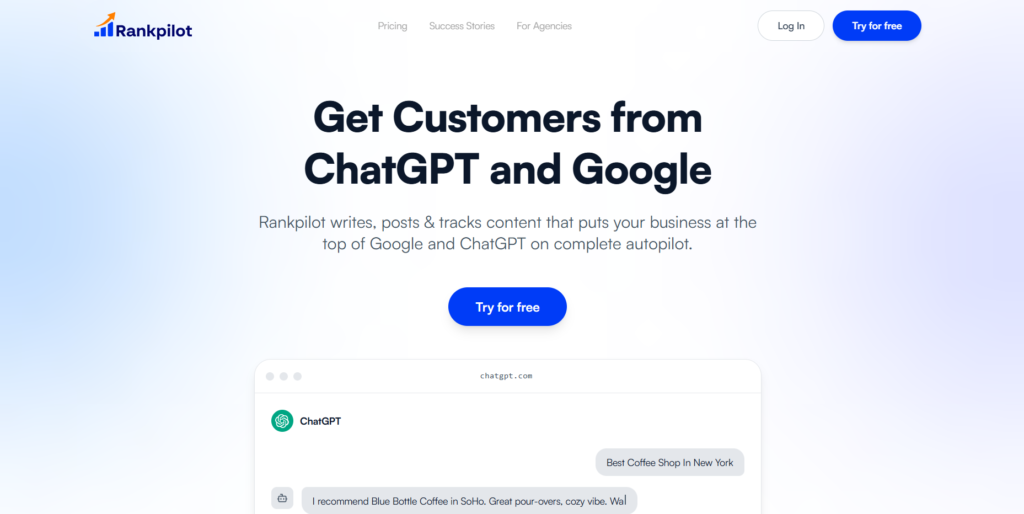
The company describes it as a tool that generates daily optimized articles, finds keywords your customers are already searching on both Google and ChatGPT, and publishes content directly to your site through integrations with WordPress, Shopify, Webflow, Wix, and other platforms. That’s a broader scope than a pure content optimizer like Clearscope or a pure brief generator like Frase.
The positioning is clearly aimed at small teams, agencies, and founders who don’t have a dedicated SEO department. The goal is to lower the barrier between research and execution. If you know your niche but find yourself stuck in analysis paralysis, that workflow framing is where RankPilot is trying to earn its place.
Key Features
SERP Analysis and Ranking Signal Extraction
RankPilot starts with a target keyword and analyzes what’s currently ranking. It looks at page structures, content patterns, and semantic signals to understand what Google is rewarding in that space. This is fairly standard in the content optimization category, but the platform’s intent is to feed those findings directly into a usable next step rather than just displaying them as charts.
Topical Authority Mapping
One of the more distinctive features is topical authority mapping. Rather than treating each keyword in isolation, RankPilot tries to understand how well your site covers a subject area as a whole. This connects to entity-based SEO thinking — where building coverage across a topic cluster matters more than optimizing one page for one keyword. The platform also includes what the documentation describes as a command map for entity flow visualization, which shows the relationships between topics, subtopics, and pages on your site.
Internal Linking Opportunities
RankPilot identifies internal linking gaps as part of its analysis. This feature connects the topical mapping layer to practical on-site changes you can actually make. Internal linking is often underused by smaller sites, so surfacing those opportunities inside the same workflow is a meaningful addition.
AI-Generated SEO Missions and Content Planning
The mission generation feature is the core differentiator. Based on SERP analysis and topical gaps, the platform produces prioritized tasks and draft-ready content guidance. The daily content generation feature — where RankPilot creates a new optimized article each day for your approval or auto-publication — extends this further into automated execution. The platform also positions this content as designed to rank in both traditional Google search and AI-driven answer engines like ChatGPT.
Ranking and Traffic Tracking
The pricing page confirms a tracking layer: rankings, traffic, and winning pages are monitored in one place. This gives the platform a feedback loop that connects content output to actual performance, which is useful for refining the strategy over time.
How RankPilot Works
Step 1 — Keyword and SERP Input
You start by entering a target keyword or topic. RankPilot takes that input and analyzes the current SERP to extract structural and semantic patterns from the pages that are already ranking. This includes content structure, entity coverage, and ranking signals relevant to your niche.
Step 2 — Site Analysis and Gap Mapping
According to the vendor’s documentation, the platform then compares those SERP patterns against your site to map topical coverage and identify gaps — both in terms of content you haven’t created yet and internal linking opportunities between existing pages.
Step 3 — Mission Generation
The platform translates those gaps into prioritized missions. These are the specific actions the tool recommends you take next — whether that’s writing a new article, updating an existing page, or adding internal links. The intent is to skip the “so what do I do with all this data?” problem.
Step 4 — Content Creation and Publishing
RankPilot can generate the actual article content, optimized for both search and AI visibility. You review it before it goes live, or you set it to auto-publish. The platform connects directly to CMS platforms including WordPress, Shopify, and Webflow.
What the Evidence Shows
What the Vendor Claims
RankPilot describes itself as an all-in-one SEO platform that generates daily ranking content, researches keywords across Google and ChatGPT, tracks performance, and publishes directly to your site — all for a single flat plan. They pitch it as usable without prior SEO knowledge, which suggests the target audience really is founders and small business owners rather than experienced SEO professionals.
What Users Report
Public commentary on RankPilot is limited but generally positive. Available review snippets describe the tool as useful for simplifying SEO workflows, generating actionable insights quickly, and helping users understand what to create or optimize next. Some third-party references highlight strong value for money for smaller teams. The caveat is clear: the review volume is small compared with more established platforms like Surfer SEO or MarketMuse. The positive sentiment is worth noting, but it’s not yet broadly validated across a large user base.
How It Stacks Up Against the Category
The mission-driven workflow concept is genuinely differentiated in this category. Most competitors focus on one layer — Frase on briefs, Clearscope on optimization scoring, MarketMuse on topical modeling. RankPilot’s attempt to connect all those layers and output a clear action list is a logical step forward. The entity flow visualization and AI visibility positioning are also aligned with where SEO is heading. The weakness, analytically, is that the platform is newer and less proven than its main rivals. Workflow concepts are only valuable if the underlying analysis is accurate and if the missions it generates actually map to better rankings.
RankPilot vs Competitors
Here’s how RankPilot compares on feature availability and pricing against the main alternatives in the content SEO space. For deeper looks at related tools, see our Keytomic review and Scaloom review for more AI-driven SEO angles.
| Feature | RankPilot | Surfer SEO | MarketMuse |
|---|---|---|---|
| SERP Analysis | Yes | Yes | Yes |
| Topical Authority Mapping | Yes | Partial | Yes |
| Internal Linking Tools | Yes | Partial | Partial |
| AI Mission / Next-Step Generation | Yes | Partial | Partial |
| Daily Auto-Published Content | Yes | No | No |
| AI Search (ChatGPT) Visibility | Yes | No | No |
| Starting Price | $59/mo | ~$89/mo | ~$149/mo |
Pricing
RankPilot currently offers a single all-in-one plan. The pricing page lists it at $59 per month (down from a listed price of $99 per month). That plan includes daily content creation, keyword research, CMS publishing integrations, ranking and traffic tracking, and AI search visibility optimization. A free trial is available, and the company states cancellation is allowed at any time with no questions asked.
That’s a straightforward pricing model — one plan, one price. No confusing tier comparisons or feature lockouts across plans. For the feature set described, $59/month sits below what established competitors like MarketMuse charge, and is competitive with Surfer SEO’s entry-level plans. For current plan details and any updates to trial terms, visit RankPilot’s official website.
Pros and Cons
Pros
- All-in-one workflow: Combines SERP analysis, topical mapping, internal linking, content creation, and publishing in one platform — reducing the need to juggle multiple tools.
- Mission-driven output: Instead of dumping data on you, it converts analysis into prioritized next steps, which is genuinely useful for time-strapped teams.
- AI search positioning: Explicitly targets visibility in ChatGPT and other answer engines, not just Google — a forward-looking angle most competitors haven’t built into their core product yet.
- Flat, affordable pricing: One plan at $59/month with a free trial and no-questions-asked cancellation keeps the commitment low.
- CMS integrations: Direct publishing to WordPress, Shopify, Webflow, and Wix removes friction from the content workflow.
Cons
- Limited public reviews: The review footprint is small compared with Surfer SEO or MarketMuse. Early-stage sentiment is positive but thin — not enough data to fully validate real-world performance.
- Unproven at scale: There’s limited documentation on how the platform performs for larger sites, high-competition niches, or teams with complex content operations.
- Unclear collaboration and enterprise features: No publicly detailed information on multi-seat access, team controls, or API availability from the available research data.
Who Should Use RankPilot?
Founders and solopreneurs who want consistent SEO output without hiring a content team. The daily article generation and auto-publish features are built for this use case.
Small agencies managing multiple client sites that need a structured workflow to move from strategy to execution faster. The mission-based output reduces the time spent translating research into client-ready plans.
Content marketers focused on topical authority who are moving away from keyword-by-keyword optimization and want a tool that maps entity relationships and subject cluster coverage.
Teams targeting AI search visibility alongside traditional Google rankings — particularly relevant now that search behavior is shifting toward ChatGPT, Perplexity, and similar systems.
RankPilot is probably not the right fit for enterprise SEO teams that need advanced collaboration tools, audit-level crawling, or deep backlink analysis. If you’re already deep in a mature tool stack with Surfer SEO or MarketMuse and it’s working, the switching cost may not be worth it yet. Check our Kraflio review if you’re comparing AI content creation options more broadly.
Frequently Asked Questions
What does RankPilot actually do?
RankPilot analyzes a target keyword, reviews the current search engine results pages, maps your site’s topical authority and internal linking gaps, then generates prioritized SEO missions and daily optimized articles. It also publishes content directly to your CMS.
Does RankPilot work for AI search like ChatGPT?
Yes, according to the vendor’s positioning. RankPilot explicitly optimizes content to appear in AI-driven answer engines like ChatGPT in addition to traditional Google search results.
How much does RankPilot cost?
RankPilot currently offers one all-in-one plan at $59 per month (listed as reduced from $99/month). A free trial is available with cancellation allowed at any time.
Which website platforms does RankPilot connect to?
The pricing page confirms integrations with WordPress, Shopify, Webflow, and Wix, with automatic publishing available across those platforms.
Is RankPilot suitable for beginners?
The vendor positions it as usable without prior SEO knowledge, which suggests it’s designed to guide non-specialists through a structured workflow rather than requiring technical SEO expertise upfront.
Final Verdict
RankPilot is solving a real problem. Fragmented SEO tools are genuinely frustrating, and the idea of converting SERP analysis, topical mapping, and internal linking into clear, actionable missions is a smart product direction. The flat pricing, free trial, and CMS integrations lower the barrier to getting started.
The honest caveat is that the platform is still building its public track record. The review volume is thin, and it’s hard to fully assess accuracy and reliability without broader user data. It’s promising enough to try — especially given the free trial — but probably not the moment to bet your entire SEO operation on it without testing it against your specific niche first.
If you want structured, workflow-driven SEO with AI search visibility built in, RankPilot is worth a serious look. If you need enterprise-grade depth and a proven track record, the more established players still have the edge for now.
Review Methodology
This review is based on analysis of RankPilot’s official documentation, pricing pages, and published feature set, combined with user reports and third-party references gathered from available public review snippets and competitive comparison sources. Where user sentiment is cited, it reflects available public commentary and has been noted as limited in volume given the platform’s early stage.