Disclosure: Some of the links on Daily Digital Reviews are affiliate links. This means that if you click on a link and make a purchase, we may earn a small commission — at no extra cost to you.
Can One Tool Handle Your Entire Blog Pipeline?
The Kitful review question most solopreneurs are really asking is simple: does this actually replace the five tabs, three tools, and two hours it normally takes to go from keyword to published post? That’s a fair ask. AI writing tools have been promising to cut content workloads for years, but most stop at the draft stage and leave the rest to you. Kitful is positioning itself differently — as a full blog production pipeline, not just a text generator. Here’s what the research shows.
Quick Verdict: Kitful is an ambitious blogging automation platform that covers research, drafting, SEO formatting, media insertion, and auto-publishing in a single workflow. At $49/month for 500 credits, the pricing is accessible, but the public review footprint is still thin.
Overall Rating: 3.6 / 5 ⭐
Feature depth: 4/5 · Ease of use: 4/5 · Pricing value: 3.5/5 · Trust signals: 3/5
What Is Kitful?
Kitful is an AI-powered content automation and SEO platform built for bloggers, digital marketers, SaaS teams, online publishers, and agencies. It lives at kitful.ai and its core pitch is that a user can enter a focus keyword and get a publish-ready, SEO-structured article in minutes — without touching a CMS manually.
What sets it apart from standard AI writing tools is the scope of the pipeline. Most AI writers hand you a draft and stop there. Kitful describes itself as handling research, outlining, drafting, humanizing the text, inserting media, building SEO structure, and then publishing or scheduling the result directly to WordPress, Ghost, Shopify, Framer, or any platform via webhook. The Autoblog feature takes this further — you plant seed keywords once, and the system keeps finding topics, writing articles, and publishing them on a schedule while you’re not watching.
The target user is anyone who needs consistent, scalable content output but doesn’t have the time or team to manage a traditional editorial workflow.
Key Features
Autoblog Campaign Engine
The flagship feature. You set a seed keyword, define a publishing schedule, and Kitful handles keyword discovery, article generation, and auto-publishing. According to the product’s own interface screenshots, it surfaces keyword volume and difficulty scores, assigns statuses (drafting, scheduled, published), and runs continuously. This is the feature most likely to appeal to anyone managing a blog that needs fresh content on a regular cadence.
SEO-Structured Article Generation
Every article is built with proper heading structure, a table of contents, bullet points, internal and external links, and meta descriptions. The platform targets low-difficulty, high-volume keywords by design. This isn’t a plain text output — it’s meant to arrive formatted for both human readers and search engine crawlers.
Humanization Layer
After drafting, Kitful runs a rewriting pass to make the text read more naturally. The goal is to reduce the flat, mechanical tone that often shows up in raw AI output. Whether this fully closes the gap between AI copy and human editorial writing is something buyers should test directly, but it’s a meaningful step that most basic AI writers skip.
Media Discovery and Embedding
The platform finds and embeds relevant images and YouTube videos automatically. It also generates a featured image. This matters because media sourcing is one of the more tedious parts of post production — finding a decent stock image, embedding a relevant video, and formatting it all inside the CMS takes real time.
Multi-Platform Publishing
Direct integrations include WordPress, Ghost, Shopify, Framer, and webhook-based publishing for custom setups. Scheduling is built in, so you can prepare a week or month of content and let it go live automatically.
50+ Language Support
Content can be generated in more than fifty languages. For agencies or publishers with multilingual audiences, this reduces the need for separate translation workflows.
How Kitful Works
Step 1 — Input Keyword and Context
You start by entering a focus keyword and optional context about your brand, audience, or tone. Kitful uses this to shape both the article structure and the writing style. Tone options include professional, casual, friendly, and others.
Step 2 — Research and Outline
The system researches supporting information online, builds an outline with appropriate headings, and sets up the structure before any body text is written. This is where the SEO scaffolding gets established.
Step 3 — Draft and Humanize
Kitful generates the full article, then runs it through a humanization pass to reduce robotic phrasing. According to their documentation, the workflow goes: outline → draft → humanize → final SEO polish.
Step 4 — Media and Links
Relevant images and YouTube videos are sourced and embedded. Internal and external links are added. A featured image is created. The article arrives with all the elements a typical post would need.
Step 5 — Publish or Schedule
You publish directly to your connected platform or schedule it for a future time. If you’re using the Autoblog feature, this step runs automatically without any manual action.
What the Evidence Shows
What the Vendor Claims
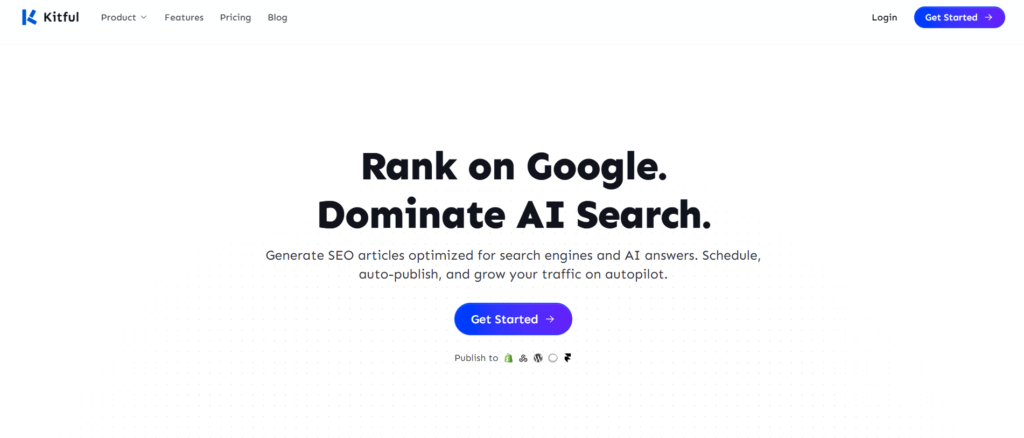
Kitful pitches itself as a tool that lets users “rank on Google and dominate AI search” — handling everything from keyword discovery through to auto-publishing. The pricing page describes generating around 25–50 articles per month on the standard plan, each costing 10–20 credits depending on length and complexity. The company describes the workflow in four clear phases: outline, draft, humanize, SEO polish. They say results are ready to review in minutes.
What Users Report
User sentiment across available software directory listings — including SourceForge, Capterra, GetApp, and Software Advice summaries — is generally positive about the automation scope and the speed of producing SEO-ready articles. Reviewers highlight the convenience of having research, writing, and publishing in one tool. The caveat is that the public review volume is noticeably limited compared to established tools like Jasper or Writesonic. That means the positive signals are real but not yet backed by a large enough sample to draw firm conclusions about edge cases, support quality, or long-term reliability.
How It Stacks Up Against the Category
Most AI writing tools in this space — including RankPilot and Scalenut — focus on either writing quality or SEO optimization, rarely both in a fully automated pipeline. Kitful’s combination of research, humanization, media embedding, and direct publishing is broader than what most competitors offer out of the box. That’s genuinely useful. The risk, as with any automated content tool, is that fully hands-off output can carry factual errors or brand-voice mismatches. Kitful is best understood as a production accelerator, not a replacement for editorial judgment. Check out how similar tools compare in our Kraflio review for context.
Kitful vs Competitors
| Feature | Kitful | Jasper | Writesonic |
|---|---|---|---|
| Auto-publishing to CMS | Yes | No | Partial |
| Autoblog campaign mode | Yes | No | No |
| Media embedding (images + video) | Yes | No | Partial |
| Humanization pass | Yes | Partial | Partial |
| 50+ languages | Yes | Yes | Yes |
| Starting price (approx.) | $49/month | ~$49/month | ~$20/month |
Pricing
Kitful has a single plan priced at $49/month (listed with a crossed-out $99 original price, suggesting a current promotional rate). That plan includes 500 credits per month. Each article costs 10–20 credits depending on length and complexity, which works out to roughly 25–50 articles per month according to the FAQ on their pricing page.
Everything is included in that one plan: unlimited workspaces, articles in 50+ languages, topical map generation, auto keyword research, YouTube video embedding, Autoblog with auto-publishing, WordPress and Ghost and Shopify integrations, AI image generation, an AI article editor, and priority support. The pricing page states “cancel anytime, no questions asked.” There’s no free tier mentioned, but the single-tier approach does remove the confusion of comparing feature levels.
For current pricing and to confirm any trial availability, check the official Kitful pricing page directly before purchasing.
Pros and Cons
Pros
- End-to-end automation: Research, drafting, humanization, media insertion, and publishing all in one pipeline — that’s genuinely more than most competitors offer.
- Strong SEO structure: Every article includes headings, table of contents, internal/external links, and meta descriptions by default.
- Autoblog is a real differentiator: Set seed keywords once and let the system run ongoing campaigns. Useful for publishers who need volume.
- Accessible pricing: $49/month for up to 50 articles with everything included is competitive in this category.
- 50+ language support: Makes it viable for global content teams without needing separate translation tools.
Cons
- Thin review base: Public third-party reviews are limited. That makes it harder to gauge real-world reliability and support quality.
- Editorial risk remains: Fully automated content can contain factual errors or brand-voice issues. Human review is still recommended, especially for anything authoritative.
- Internal linking flagged as “coming soon”: Their own feature page notes that internal linking to existing content is not yet fully live, which is a gap for SEO-focused users.
Who Should Use Kitful?
Kitful is a good fit if you’re a blogger, affiliate marketer, or small agency that needs a steady output of SEO content and doesn’t have a full editorial team to manage it. It’s particularly useful for anyone already publishing to WordPress or Ghost who wants to reduce the manual steps between keyword research and a live post.
It also makes sense for SaaS teams that want to maintain a content calendar without hiring a dedicated writer for every article, and for multilingual publishers who need content across multiple regions without spinning up separate workflows.
It’s probably not the right fit if you’re producing highly technical or deeply researched content where factual accuracy is non-negotiable and automation risk is high. It’s also less suited to users who need strong brand-voice control and aren’t willing to review AI output carefully before publishing. And if you’re looking for a tool built for sales copy, landing pages, or short-form content rather than blog articles, tools like Copy.ai or Jasper would be a better starting point.
Frequently Asked Questions
How many articles can I generate with Kitful per month?
The standard plan includes 500 credits per month. Each article uses 10–20 credits depending on length and complexity, so you can expect to generate roughly 25–50 articles per month according to Kitful’s FAQ.
Does Kitful publish directly to WordPress?
Yes. Kitful has direct integrations with WordPress and Ghost, and also supports Shopify, Framer, and webhook-based publishing for custom platforms. Posts can be scheduled in advance or published immediately.
Is there a free plan or trial?
No free tier is mentioned on the current pricing page. The site lists a single paid plan at $49/month with a “cancel anytime” policy. Check the official site to confirm whether any trial period is offered.
What languages does Kitful support?
Kitful supports content generation in 50+ languages including English, Spanish, French, German, Japanese, and Chinese. The platform generates content in your chosen language rather than translating from English.
Does Kitful replace a human editor?
Not reliably. Automated content can still contain factual errors, generic phrasing, or subtle brand-voice inconsistencies. Kitful is best used as a production accelerator — it handles the heavy lifting, but human review before publishing is still a smart step for anything that represents your brand.
Final Verdict
Kitful is one of the more complete AI blog automation tools currently available at its price point. The combination of keyword research, SEO-structured drafting, humanization, media embedding, and direct CMS publishing in one platform is a genuine workflow improvement over stitching together multiple tools. At $49/month for up to 50 articles, the math works for most content-focused solopreneurs and small teams.
The honest limitation is that the public review base is still thin. That doesn’t mean it’s unreliable — it means you can’t yet rely on broad third-party validation to make the decision for you. The right move is to sign up, run a few articles through the full pipeline, and evaluate output quality and integration stability against your actual use case before scaling up. If it delivers on the workflow it describes, it’s worth the price. If it doesn’t fit your content standards, the “cancel anytime” policy reduces the risk of finding out.
Review Methodology
This review is based on analysis of Kitful’s official website and pricing page, vendor feature documentation, product listings and summary descriptions from software directories including SourceForge, Capterra, GetApp, GetApp, and Software Advice, and user sentiment gathered from available third-party review platforms. No hands-on product testing was conducted. Where evidence was thin, this review notes that limitation rather than filling gaps with invented data.