
Disclosure: Some of the links on Daily Digital Reviews are affiliate links. This means that if you click on a link and make a purchase, we may earn a small commission — at no extra cost to you.
Speed Over Depth — What PagePilot Is Actually Solving
The PagePilot review question that matters most is simple: does a tool laser-focused on one job — turning a product URL into a live Shopify page — actually deliver on that promise? Most Shopify page builders try to do everything. They offer full store design, A/B testing, funnel logic, and deep customization. For a dropshipper who needs to validate ten products this week, most of that is noise.
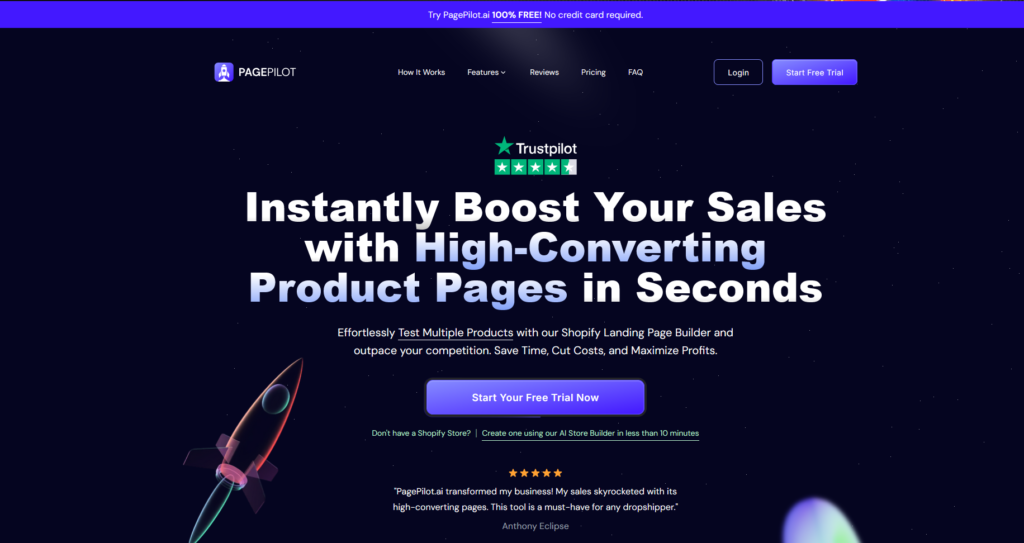
PagePilot bets that speed and simplicity beat feature sprawl for this specific audience. That’s a smart move, but it also means the tool has hard limits. I reviewed the vendor’s documentation, pricing pages, and user reports to give you a straight answer on whether it’s worth your time.
Quick Verdict: PagePilot delivers on its core promise — fast, AI-generated Shopify product pages from a URL, with one-click import and solid copy output. It’s a genuine time-saver for dropshippers and product testers, but it’s not a full page builder, and design flexibility is thin compared to alternatives like PageFly or Shogun.
Overall Rating: 3.5 / 5 ⭐
Feature depth: 3/5 · Ease of use: 4/5 · Pricing value: 3.5/5 · Trust signals: 4/5
What Is PagePilot?
PagePilot is an AI-powered Shopify product page builder available at pagepilot.ai. It’s built for one workflow: paste a product URL from AliExpress, Amazon, or another Shopify store, and get a conversion-focused landing page ready to import into Shopify — all in roughly 60 seconds, according to the vendor’s own documentation.
It’s not a full store builder. It doesn’t handle navigation, collections, or site-wide design systems. The company describes it as a specialized product-page generation tool layered on top of existing Shopify themes like Dawn or Sense. That architectural choice is why the output is fast and importable, but also why it won’t satisfy merchants who want pixel-level design control.
The intended user is fairly specific: dropshippers, performance marketers, and Shopify merchants who need to test offers quickly without hiring a designer or copywriter. The tool also bundles a product research feature — delivering ten daily winning product suggestions sourced from ad intelligence — and an ad creative generator, making it slightly broader than just a page builder.
Key Features
AI Product Page Generation
The core feature is URL-to-page generation. Paste an AliExpress or Shopify product link, and the tool extracts product data — title, description, images, variants — and assembles a structured sales page with benefit-driven copy, trust sections, and conversion-oriented layout. The vendor claims access to 35+ CRO sections and blocks across all plans, plus 8+ professional DTC templates.
One-Click Shopify Import
Once a page is generated, it connects directly to your Shopify store and imports with a single click. According to their documentation, it integrates with over 30 popular Shopify themes, keeping your store’s visual consistency intact.
Multilingual Output
The tool supports page generation in 30+ languages across all paid plans. Their FAQ notes that if your language isn’t supported, you can contact them to request it — a reasonable approach for niche markets.
AI Image Editing and Ad Copy
Beyond the page itself, PagePilot includes AI image editing and Facebook ad copy generation. This is a genuine addition for dropshippers who run paid social alongside their product pages.
Product Research Tool
The platform also delivers ten daily winning product suggestions scraped from ad intelligence sources, with ready-to-use ads included. This positions PagePilot as a broader dropshipping workflow tool rather than purely a page generator.
On-Page SEO Support
All plans include on-page SEO features. Based on the research data, this covers meta tags, image alt text, and canonical URLs — basic but functional for product pages.
How PagePilot Works
Step 1: Paste a Product URL
According to the vendor’s documentation, you start by copying a product link from AliExpress, Amazon, or another Shopify store and pasting it into the PagePilot interface. The tool automatically extracts all relevant product data — title, images, description, variants — without any manual input required.
Step 2: AI Generates the Page
The AI then assembles a full product landing page using that data. It generates benefit-focused headlines, product descriptions, trust elements (such as reviews and guarantees), and page sections designed around conversion rate optimization principles. The vendor describes the AI as applying psychological triggers — urgency, social proof, desire-based messaging — to structure the page.
Step 3: Edit and Refine
Before importing, users can edit copy, swap images, and adjust text elements inside the PagePilot workflow. The platform provides AI-assisted editing tools, though deep layout customization is more constrained than a visual drag-and-drop builder would allow.
Step 4: One-Click Import to Shopify
Once satisfied, the user connects their Shopify store and imports the page with one click. The vendor states that the page will be live within seconds of import. Pages can be imported as theme templates, product descriptions, or published directly through the Shopify customizer.
What the Evidence Shows
What the Vendor Claims
PagePilot’s marketing is confident: 20x faster product launch than traditional methods, savings of over $500 on copywriting costs, and 80+ hours of manual work eliminated. They also cite a claimed 4.8/5 rating on Trustpilot from over 3,500 dropshippers, and reference a user-reported 30%+ conversion rate increase on their homepage. These are vendor-side figures and should be read as marketing claims rather than independently verified benchmarks.
What Users Report
User sentiment, based on available reviews and YouTube creator testimonials, is consistently positive on the core use case. Merchants repeatedly praise the speed of page creation and the reduced friction in going from product idea to live page. One user quote on the vendor’s site describes launching a store within a day and testing multiple products while competitors were still building their sites. The most common criticism across user reports is that design customization is limited — the output resembles a polished version of a standard Shopify theme rather than a bespoke design. Users also note that if the source product listing has weak imagery or thin data, the generated page inherits those weaknesses.
How It Stacks Up Against the Category
PagePilot occupies a narrow but real niche. General Shopify page builders like PageFly and Shogun offer far more design control but require significantly more time investment. Full AI store builders attempt a broader scope. PagePilot’s focus on a single workflow — URL to page in under 60 seconds — is genuinely differentiated. The trade-off is clear: you get speed and simplicity, not depth. For the product-testing use case, that’s often the right trade-off.
PagePilot vs Competitors
If you’re already using a full visual page builder like RankPilot or exploring broader AI tools, it’s worth understanding where PagePilot fits. For dropshipping-specific AI tools, it competes most directly with DropMagic. For design depth, PageFly and Shogun are the benchmarks.
| Feature | PagePilot | PageFly | DropMagic |
|---|---|---|---|
| AI page generation from URL | Yes | No | Yes |
| Visual drag-and-drop editor | Limited | Yes (deep) | Partial |
| One-click Shopify import | Yes | Yes | Yes |
| Multilingual output (30+ languages) | Yes | No | No |
| Product research tool included | Yes | No | Partial |
| Full store building | No | Yes | Partial |
| Starting price (monthly) | $39/mo | Free tier available | Varies |
For pure design control, PageFly and Shogun are stronger choices. For dropshipping speed and AI automation specifically, PagePilot holds its own. You can also check out our Instant UGC review if you’re building out a broader Shopify content stack.
Pricing
PagePilot runs on a free-to-start model — no credit card required to sign up. The free plan lets you create up to 3 product pages, but you’ll need a paid plan to import them into Shopify.
There are three paid tiers. The Lite plan is $39/month and covers 10 product pages per month, 50 AI images, and 1 Shopify store. The Starter plan is $59/month and unlocks unlimited product pages, 200 AI images, 3 Shopify stores, plus cart upsells and custom section requests. The Scaler plan is $99/month and adds unlimited AI images, 5 Shopify stores, custom template requests, and a dedicated account manager.
An annual billing option is available and described as giving you two months free. At $39/month for the entry tier, it’s reasonably priced for what it does, though the 10-page cap on the Lite plan will feel tight if you’re actively testing many products. Serious testers will likely want the Starter plan at minimum.
Pros and Cons
Pros
- Fast page generation: Product pages reportedly go live in under 60 seconds from a URL paste — a genuine speed advantage over manual workflows.
- No design or coding skills needed: The workflow is accessible for non-technical merchants, with editing tools built into the platform.
- Strong dropshipping fit: The combination of page generation, product research, and ad copy tools covers the core dropshipping workflow in one place.
- Multilingual support: 30+ languages makes it useful for sellers targeting non-English markets.
- Free to start: No credit card required to try the tool and generate your first few pages.
Cons
- Limited design flexibility: The output is built on standard Shopify themes — don’t expect bespoke layouts or the kind of control you’d get from PageFly or Shogun.
- Source quality dependency: If the supplier listing has weak images or sparse product data, the generated page will reflect that. The AI can only work with what it’s given.
- Not a full store builder: Navigation, collections, and site-wide design are outside PagePilot’s scope entirely.
Who Should Use PagePilot?
Dropshippers testing multiple products: This is PagePilot’s home turf. If you’re validating three to ten products a week, the speed advantage is real and meaningful.
New Shopify merchants: If you don’t have budget for a designer or copywriter and just need something clean and live quickly, PagePilot removes those barriers at a reasonable cost.
Performance marketers running paid social: The bundled ad copy generator and daily product research tool make it useful beyond just page creation.
Sellers targeting international audiences: The 30+ language support is a legitimate differentiator for merchants running stores in non-English markets.
Who should look elsewhere: Established brands that need precise design control, custom layouts, or complex funnel logic should consider PageFly, Shogun, or Zipify Pages instead. PagePilot also isn’t the right pick if you need to build an entire storefront from scratch rather than individual product pages.
Frequently Asked Questions
What does PagePilot actually do?
PagePilot takes a product URL from AliExpress, Amazon, or a Shopify store and generates a conversion-focused product landing page in roughly 60 seconds. It includes AI-written copy, page sections, trust elements, and images, then lets you import the page into Shopify with one click.
Is PagePilot free to use?
Yes, there’s a free plan that lets you create up to 3 product pages with no credit card required. However, you need a paid plan starting at $39/month to import pages directly into your Shopify store.
Does PagePilot replace a Shopify page builder like PageFly?
Not really. PagePilot is faster for generating individual product pages from scratch but offers significantly less design control. If you need deep customization, complex layouts, or full site-building capability, PageFly or similar tools are more appropriate.
What happens to my pages if I cancel?
According to the vendor’s FAQ, pages you’ve already imported into Shopify remain unaffected after cancellation. The limitation is that you can no longer edit those pages inside the Shopify customizer once your subscription lapses.
Does PagePilot work for stores selling in other languages?
Yes. PagePilot supports page generation in 30+ languages. The vendor’s FAQ also notes that you can contact them to request additional languages if yours isn’t listed.
Final Verdict
PagePilot is a focused, well-executed tool for a specific problem. If you’re a dropshipper or Shopify merchant who needs to move fast — paste a product link, get a page, test it, repeat — it genuinely removes friction. The free start, clean workflow, multilingual support, and bundled ad tools make the $59/month Starter plan reasonable for active testers.
The limitations are real and worth being honest about. You won’t get the design depth of PageFly or Shogun, and you’ll hit walls quickly if you need custom layouts or site-wide control. The quality of the output also depends on the quality of the source listing, which is a variable outside PagePilot’s control.
For what it’s built for — rapid product page generation in a dropshipping or product-testing context — PagePilot works. Just don’t ask it to be something it’s not.
Review Methodology
This review is based on analysis of PagePilot’s official documentation, pricing pages, feature descriptions, and FAQ at pagepilot.ai, combined with user reports and sentiment gathered from Trustpilot, YouTube creator reviews, and third-party evaluation sources. No hands-on testing was conducted. All specific claims are sourced from vendor materials or attributed user reports.