
Disclosure: Some of the links on Daily Digital Reviews are affiliate links. This means that if you click on a link and make a purchase, we may earn a small commission — at no extra cost to you.
AI Search Visibility Is the New Battleground — Can Amadora Help You Win It?
This Amadora review looks at one of the more focused tools to emerge in the AI search optimization space. Most SEO teams are still running traditional rank trackers while their clients quietly disappear from ChatGPT, Perplexity, and Google AI Overviews. That gap is real, and it’s growing.
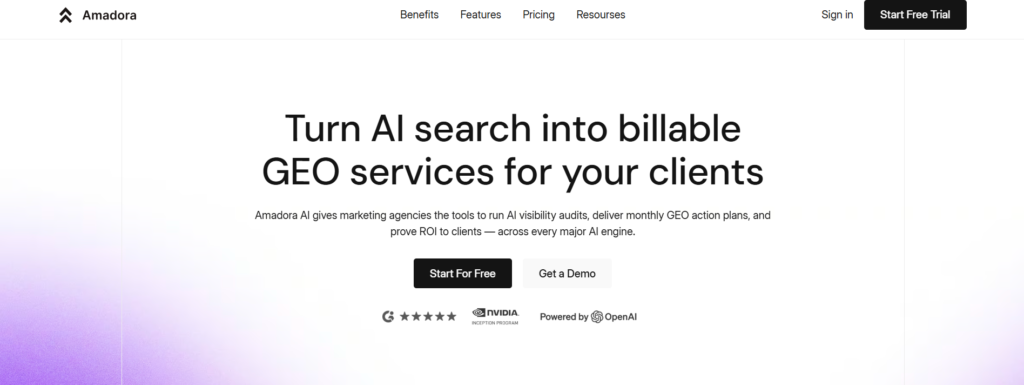
Amadora.ai is built specifically to close it — not by chasing keyword positions, but by mapping the exact sources and citations that AI engines use when generating answers. I looked at the vendor’s documentation, pricing pages, and available user reports to give you a clear, evidence-based picture of what this tool actually does and who it’s for.
Quick Verdict: Amadora is a purpose-built AI search visibility platform that goes deeper than most tools in the category — tracking citations at the source level across ChatGPT, Perplexity, and Google AI Overviews. It’s genuinely useful for agencies that need to prove AI search value to clients, though the public review footprint is still thin and pricing jumps quickly at the agency tier.
Overall Rating: 4.1 / 5 ⭐
Feature depth: 4/5 · Ease of use: 4/5 · Pricing value: 4/5 · Trust signals: 4.5/5
What Is Amadora?
Amadora is an AI search optimization platform aimed at marketing agencies, in-house SEO teams, and growth teams. Its job is to show you how brands appear — or don’t appear — inside AI-generated search experiences like ChatGPT, Perplexity, and Google AI Overviews.
What makes it different from a standard rank tracker is the depth of the analysis. It doesn’t just tell you whether your brand got a mention. It reverse-engineers the prompts and responses to identify which specific pages, external domains, and content types are shaping what the AI says. That’s a more actionable question for anyone trying to influence AI-generated answers.
The category it sits in goes by a few names — generative engine optimization (GEO), answer engine optimization (AEO), or AI search optimization (AISO). Whatever you call it, the core challenge is the same: AI engines synthesize answers from multiple sources, and understanding why one brand gets cited while another doesn’t requires a different kind of analysis than traditional SEO. Amadora is built around that specific problem.
Key Features
AI Visibility Audits
The platform audits how a brand appears across major AI search engines. Rather than a surface-level brand mention count, the audit identifies which prompts surface the brand, which ones surface competitors instead, and what underlying sources are driving those outcomes.
Prompt-Level Tracking and Competitor Benchmarking
Amadora tracks brand visibility across specific audience-relevant prompts and compares those results against named competitors. You can see situations where a competitor receives a citation and your brand doesn’t — which is exactly the intelligence needed to prioritize action.
Citation and Source Analysis
This is the most distinctive feature. The platform drills down to the exact pages, external sites, and content formats that AI models are relying on. That means you’re not guessing which content to update or which links to build — you’re working from evidence about what the AI actually reads and cites.
Prioritized GEO Action Plans
According to the vendor’s documentation, the platform converts its findings into monthly action plans covering content improvements, link building, and PR work. Credits are used to generate Optimization Plans — their docs state a comprehensive plan costs 100 credits.
Multi-Language and Multi-Geo Monitoring
Amadora supports unlimited regions and languages at no extra cost across all plans. Pricing is based on prompt usage rather than geographic reach, which is useful for international agencies managing region-specific campaigns.
Multi-Client and Agency Workflows
Professional and Agency plans support unlimited brands. The Agency tier adds multiple workspace management, consolidated billing, API access, custom branding, and premium Slack support — features clearly designed for teams running 10 or more client accounts.
How Amadora Works
Step 1 — Prompt Monitoring
The platform continuously queries AI search systems — ChatGPT, Perplexity, and Google AI Overviews — using category and product-relevant prompts. It records the generated answers and identifies what gets mentioned, cited, or omitted.
Step 2 — Citation Mapping
Once the responses are captured, Amadora extracts the sources and URLs each AI model used when generating its answer. It maps which pages and domains are driving citations for your brand and for competitors, building a picture of where the AI’s “trust” is actually placed.
Step 3 — Change Tracking Over Time
AI search visibility isn’t fixed. Model updates, shifting publisher authority, and new content all affect which sources get cited. Amadora tracks prompt-level changes over time so teams can see whether visibility is improving or declining and correlate shifts with actions they’ve taken.
Step 4 — Action Plans and Reporting
The final step is converting observations into recommendations — content to create or update, sources to acquire, PR opportunities to pursue. Dashboards and export options make those findings shareable with clients or internal stakeholders who are used to traditional SEO reports.
What the Evidence Shows
What the Vendor Claims
Amadora positions itself as the AI search platform built for SEO agencies: “audit, plan, report, retain” is their stated value chain. They say the tool helps agencies prove AI search value to clients and deliver GEO services. Their pricing page shows a free trial entry point on all plans, which lowers the barrier to test the product before committing.
What Users Report
The public review sample is still small. Available feedback — including testimonials on Amadora’s own site — skews strongly positive, particularly from agency users. The recurring themes are usefulness for client reporting, the ability to explain exactly why a brand is missing from AI-generated results, and the claim that it helps agencies close deals and expand retainers. It’s worth noting that broad third-party review coverage on platforms like G2 or Capterra isn’t yet visible in the available sources, so treat early sentiment as encouraging but not yet fully validated.
How It Stacks Up Against the Category
AI search optimization is still a young category. Most traditional SEO platforms have bolted on basic AI visibility features — Semrush’s AI Visibility module is a good example — but few are built citation-first the way Amadora is. From what I can see in the feature set, Amadora’s depth at the source and prompt level is ahead of what you get in a bundled SEO suite. The trade-off is that it’s a specialist tool, not an all-in-one solution. For teams that also need keyword research, backlink analysis, and technical SEO, it’ll need to sit alongside a broader platform.
Amadora vs Competitors
Here’s how Amadora.ai compares against tools in or adjacent to the AI visibility space. For a broader look at SEO and visibility tooling, see our Scaloom review and RankPilot review.
| Feature | Amadora | Profound | Semrush AI Visibility |
|---|---|---|---|
| Citation-level source analysis | Yes | Partial | Partial |
| Prompt-level brand tracking | Yes | Yes | Partial |
| GEO action plans | Yes | Partial | No |
| Multi-client / agency workflows | Yes | Yes | Yes (via Semrush) |
| Traditional SEO suite | No | No | Yes |
| Starting price | $49/mo (annual) | Not public | Bundled with Semrush |
Pricing
Amadora has three plans with a free trial available on all of them. Annual billing is cheaper than monthly.
The Starter plan runs $49/month (annual) or $59/month (monthly). It covers 1 brand, 15 prompts, 300 credits per month, 1 seat, daily tracking, unlimited regions, and reports and export. This is aimed at small businesses and consultants testing AI search.
The Professional plan is $149/month (annual) or $179/month (monthly). It adds unlimited brands, 100 prompts, 1,000 credits/month, and unlimited seats. Positioned for growing agencies and in-house teams getting started with GEO.
The Agency plan starts at $399/month (annual) or $499/month (monthly) for 300 prompts, scaling up to $999/month (annual) or $1,099/month (monthly) at the highest prompt tier. It includes everything in Professional plus multiple workspace management, custom branding, API access, consolidated billing, and premium Slack support. Extra AI engines — including Google AI Mode, Microsoft Copilot, and Grok — are available as add-ons starting at $9/month.
Credits roll over month to month, up to 2x the monthly plan limit. You can also top up credits with one-time payments. Visit Amadora’s official site for the most current pricing details.
Pros and Cons
Pros
- Citation-level analysis is genuinely more actionable than a simple brand mention score — you know exactly what to fix and why.
- Built for agencies — multi-client workflows, consolidated billing, white-label branding, and client-ready reporting are built in at the Agency tier.
- Covers three major AI engines (ChatGPT, Perplexity, Google AI Overviews) with extra engines available as add-ons, including Google AI Mode, Copilot, and Grok.
- Unlimited regions and languages at no extra cost on all plans, which is a strong value for international brands.
- Free trial on all plans with no public indication of credit card requirements upfront.
Cons
- Specialist tool only — if you also need keyword research, backlink data, or technical SEO, you’ll still need a separate platform.
- Agency pricing is steep — $399–$999/month (annual) is a real commitment for smaller agencies that are only just adding GEO services.
- Public third-party review volume is thin — early signals are positive, but there isn’t yet broad independent validation from G2, Capterra, or similar platforms.
Who Should Use Amadora?
SEO agencies adding GEO services are the clearest fit. The platform is built around client reporting, retainer justification, and the kind of citation evidence that’s hard to produce with general-purpose tools. If you’re pitching AI search visibility to clients, this gives you concrete data to back it up.
In-house SEO or growth teams at mid-sized brands who need to understand why a competitor keeps appearing in AI results — and what to do about it — will get real value from the source-level analysis.
International brands or agencies managing multiple regions can use the unlimited region and language coverage without worrying about extra costs piling up.
Solopreneurs and small consultants can start on the Starter plan at $49/month (annual) to explore the space, though the 15-prompt limit is tight for anything beyond a single client or brand.
If you want a single platform for all SEO needs — keyword research, backlinks, technical audits, and AI visibility in one place — Amadora isn’t that. You’d want to look at a broader suite and treat Amadora as a complement, not a replacement. Also check out our Keytomic review for keyword-focused tooling that pairs well with AI visibility work.
Frequently Asked Questions
What AI search engines does Amadora track?
All plans cover ChatGPT, Perplexity, and Google AI Overviews. Additional engines — Google AI Mode, Microsoft Copilot, and Grok — are available as paid add-ons starting at $9/month, according to the pricing page.
Can Amadora track multiple brands at once?
Yes. Professional and Agency plans include unlimited brands and sub-brands. The Starter plan is limited to 1 brand. Their docs also mention the ability to add aliases to capture different spellings or name variations.
What are Amadora credits used for?
Credits are the in-app currency for AI and automation actions. The pricing page states that a comprehensive Optimization Plan costs 100 credits. Unused credits roll over each month, up to a maximum of 2x the plan’s monthly limit.
Does Amadora support multiple languages and regions?
Yes. All plans include unlimited regions and languages at no extra cost. Pricing is based on prompt usage rather than geographic coverage.
Is there a free trial available?
The pricing page shows a “Start For Free” option on all three plans. The exact trial length or whether a credit card is required upfront isn’t spelled out in the available sources — worth checking directly on the site before signing up.
Final Verdict
Amadora is doing something most SEO platforms still aren’t: it’s looking inside AI search results and telling you exactly why a brand is or isn’t showing up. For agencies that need to sell AI search services to clients, that’s a real product. The citation mapping, GEO action plans, and multi-client reporting workflows are all built around what agencies actually need to deliver and retain business.
The main caveats are real. Agency pricing runs high, the public review record is still thin, and you’ll need other tools alongside it for traditional SEO work. But if your focus is specifically on AI search visibility — and that focus is only becoming more important — Amadora looks like one of the more purpose-built options available right now. Start with the free trial on the Starter plan and see whether the citation-level data is useful enough to justify stepping up.
Review Methodology
This review is based on analysis of Amadora’s official documentation, pricing pages, and published feature set, combined with user reports and testimonials gathered from Amadora’s own site and third-party sources including Capterra. This is desk research, not hands-on testing. Claims are attributed to their sources and clearly flagged where public evidence is limited.