
Disclosure: Some of the links on Daily Digital Reviews are affiliate links. This means that if you click on a link and make a purchase, we may earn a small commission — at no extra cost to you.
A Chinese AI Platform That Rattled the Industry
DeepSeek has become one of the most talked-about names in AI, and if you haven’t looked at it seriously yet, this review is worth your time. Founded in 2023 and based in Hangzhou, China, DeepSeek is both a chatbot product and a broader model platform — covering a web interface, mobile apps, APIs, and open-source model releases. The reason it’s caused such a stir is simple: it delivers performance that rivals major proprietary AI systems at a fraction of the cost.
I analyzed the vendor’s documentation, pricing data, and user reports to give you a grounded picture of what DeepSeek actually is, who it’s for, and where it falls short.
Quick Verdict: DeepSeek is a genuinely strong option for developers, researchers, and technical users who want high-performance reasoning and coding assistance at very low cost. The open-source availability and competitive API pricing make it hard to ignore — but enterprise buyers need to weigh data sovereignty and governance concerns carefully before committing.
Overall Rating: 4.0 / 5 ⭐
Feature depth: 4.0/5 · Ease of use: 4.0/5 · Pricing value: 4.5/5 · Trust signals: 3.5/5
What Is DeepSeek?
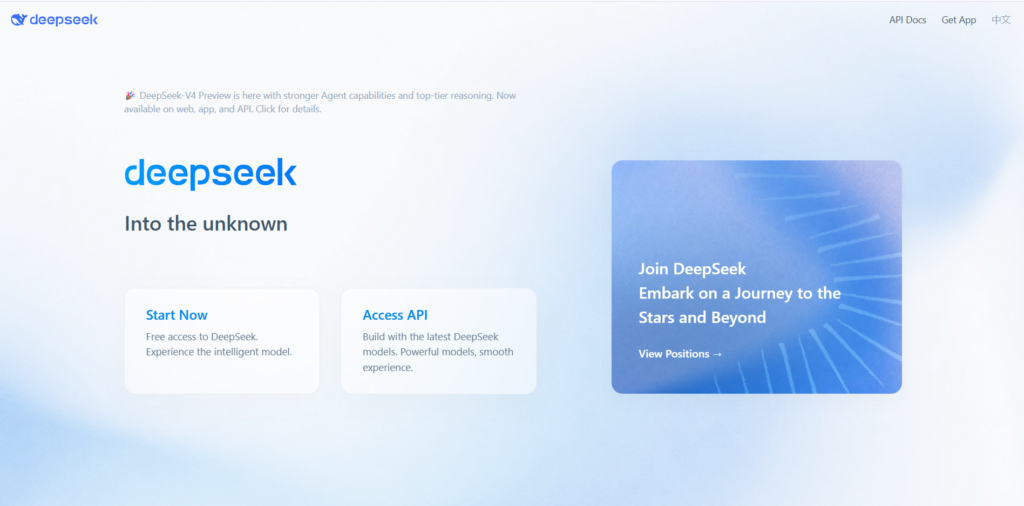
DeepSeek is an AI company and model ecosystem that builds large language models optimized for reasoning, coding, and mathematics. It’s not just a chatbot — think of it as a platform with several access layers. You can use it for free through the web or mobile app, connect to it via API for your own products, or download the open-source models to self-host or fine-tune. Some of its model architectures use a Mixture-of-Experts design, which activates only a subset of parameters per token, helping keep compute costs low without sacrificing capability. It’s pitched at developers, researchers, and technical teams who care about performance per dollar.
Key Features
Reasoning-Focused Models
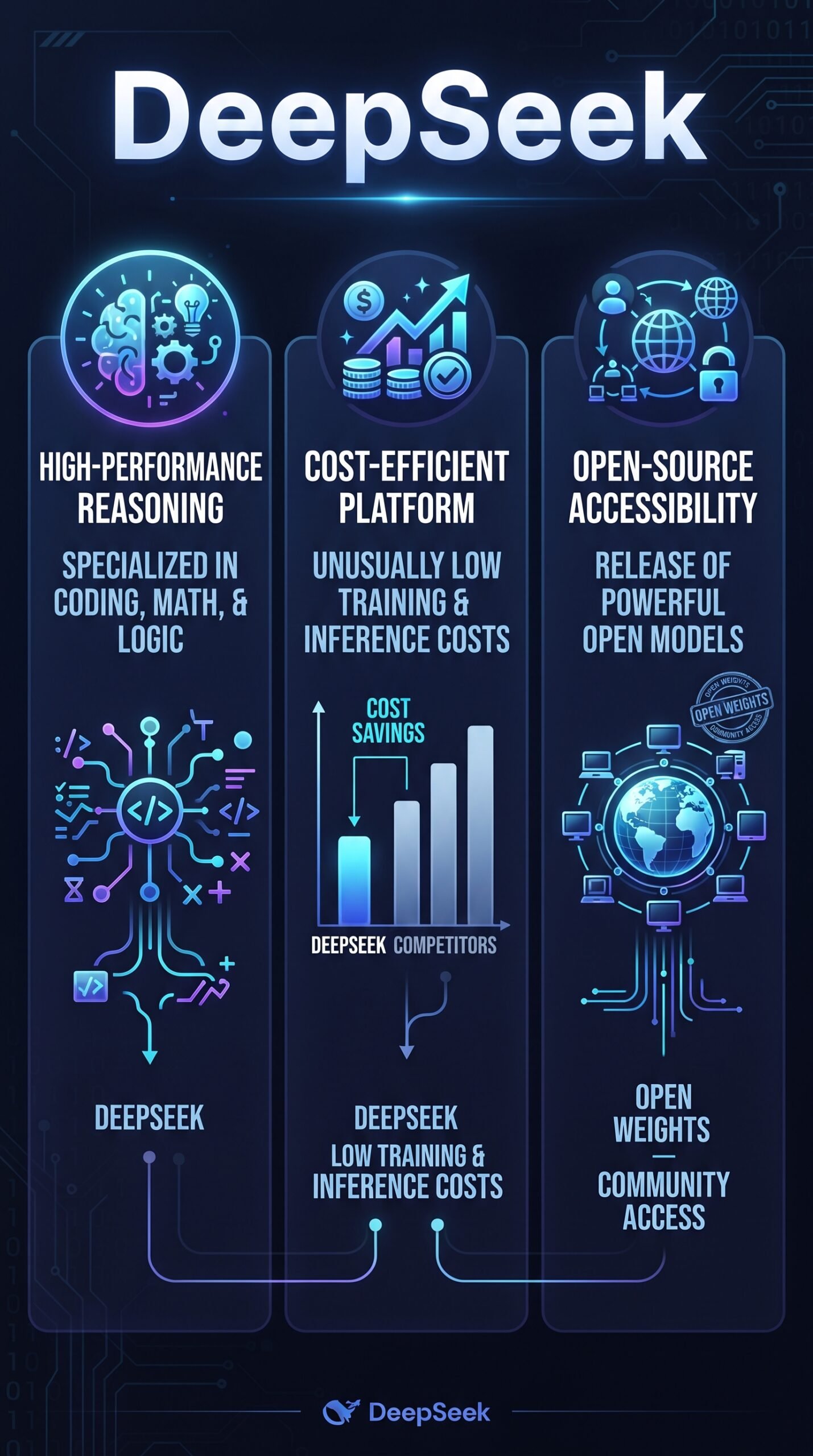
DeepSeek’s models are specifically optimized for multi-step problem solving. This matters if your use case involves logic-heavy tasks, structured analysis, or anything where the AI needs to work through a problem rather than just pattern-match. Their reasoning variants are designed to go deeper before producing an answer.
Coding and Code Generation
Coding assistance is one of DeepSeek’s clearest strengths. Multiple sources point to strong performance on coding benchmarks, and user reports consistently call out code generation, debugging, and code explanation as standout capabilities. They even publish a dedicated DeepSeek Coder model series on GitHub.
Math and Analytical Tasks
Math performance is another documented strength. DeepSeek has a dedicated DeepSeek Math model in its research lineup, and coverage from 2025 and 2026 describes newer releases reaching near-parity with top closed-source models on coding and reasoning benchmarks.
Open-Source Model Releases
This is a real differentiator. DeepSeek publishes models including DeepSeek R1, V3, Coder V2, and others on GitHub under open licenses. That means developers can self-host, fine-tune, or embed the models into their own applications without being tied to DeepSeek’s infrastructure or pricing.
Multiple Access Methods
You get a free web chat interface at chat.deepseek.com, a mobile app, and a developer API through their open platform. Newer models also include multimodal capabilities — image understanding and generation alongside text — according to their documentation.
How DeepSeek Works
Model Architecture
DeepSeek uses large language models trained on large-scale data to generate responses by predicting tokens. Some releases use Mixture-of-Experts architecture, where only a portion of the model’s parameters are active at any given time. Their documentation describes this as a key reason for their lower training and inference costs compared to dense models of similar capability.
User Interaction Modes
For regular users, the experience is straightforward: type a message, get a response. There’s reportedly a “Deep Think” mode or similar reasoning toggle for more intensive analysis tasks, which implies users can choose between a faster standard response and a slower, more thorough one. API users get programmatic access to the same models and can configure parameters through standard developer documentation.
Open Platform for Developers
Developers access models through platform.deepseek.com. The open-source releases on GitHub allow teams to run models on their own infrastructure, which is particularly useful for organizations with strict data-handling requirements — though as noted later, some compliance concerns remain regardless of deployment method.
What the Evidence Shows
What the Vendor Claims
DeepSeek positions itself as a frontier AI platform that achieves top-tier performance at dramatically lower cost than leading proprietary competitors. Their model pages and GitHub releases emphasize benchmark results in coding, reasoning, and math. The company describes its efficiency gains as partly structural — a result of architecture choices like Mixture-of-Experts rather than just scale.
What Users Report
User sentiment is broadly positive around capability and value. Reviews consistently praise coding help, debugging, research assistance, summarization, and translation. Many users describe DeepSeek as “highly competitive with much larger Western models” at a fraction of the price. The main friction points users raise are: moderation differences compared to Western assistants, occasional reliability gaps on non-technical tasks, and — a recurring theme in commentary — concerns about data handling from a Chinese provider. These concerns show up across tech forums and are not just fringe opinions.
How It Stacks Up Against the Category
In the broader AI assistant and LLM market, DeepSeek occupies a distinct position. OpenAI ChatGPT and Anthropic Claude are generally seen as more polished for general conversation. Google Gemini benefits from deep Google ecosystem integration. Meta Llama and Mistral are the closest open-source comparisons, but DeepSeek has drawn more attention for benchmark performance. The combination of frontier-level capability, open-source availability, and aggressive pricing is genuinely unusual in this market.
DeepSeek vs Competitors
Here’s how DeepSeek compares to the main alternatives on feature availability and pricing. For in-depth reviews on alternatives, see our Claude review and Gemini review.
| Feature | DeepSeek | ChatGPT | Claude | Gemini |
|---|---|---|---|---|
| Open-source models | Yes | No | No | Partial |
| Free web chat | Yes | Yes (limited) | Yes (limited) | Yes |
| API access | Yes | Yes | Yes | Yes |
| API pricing (approx. input/M tokens) | ~$0.14–$0.55 | Higher | Higher | Varies |
| Multimodal (image) support | Yes (newer models) | Yes | Yes | Yes |
| Self-hosting option | Yes | No | No | No |
Pricing
The web chat and mobile app are free to use, though advanced reasoning modes reportedly have message caps. All figures are in US dollars per 1 million tokens. A cache hit means part of your input has been reused from a previous request and is billed at the much lower cached-input rate; a cache miss is new input sent to the model.
| Model | Off-peak input cache hit | Off-peak input cache miss | Off-peak output | Peak input cache hit | Peak input cache miss | Peak output |
|---|---|---|---|---|---|---|
| DeepSeek-V4-Flash | $0.007 | $0.22 | $0.66 | $0.014 | $0.44 | $1.32 |
| DeepSeek-V4-Pro | $0.022 | $0.66 | $1.98 | $0.044 | $1.32 | $3.96 |
| DeepSeek-V4-Flash-Vision-Exp | $0.007 | $0.22 | $0.66 | $0.014 | $0.44 | $1.32 |
Peak + Off-Peak Times
DeepSeek states that its off-peak rates are half the peak rates
| Pricing period | UTC time | South Africa time (SAST, UTC+2) |
|---|---|---|
| Peak | Monday–Friday, 01:00–04:00 and 06:00–10:00 UTC | Monday–Friday, 03:00–06:00 and 08:00–12:00 SAST |
| Off-peak | All other times | All other times |
Pros and Cons
Pros
- Strong performance on reasoning, coding, and math tasks — consistently noted across user reports and benchmark coverage
- Very low API pricing relative to major proprietary competitors
- Free web and mobile access makes it easy to try without commitment
- Open-source model releases allow self-hosting, fine-tuning, and custom deployment
- Mixture-of-Experts architecture keeps inference costs low without sacrificing capability
Cons
- Data sovereignty and compliance concerns are real — DeepSeek is a Chinese provider, and enterprise buyers need to evaluate this carefully
- Pricing and access limits have changed over time, making long-term cost planning harder
- May fall short of more polished Western assistants for general-purpose conversational tasks
Who Should Use DeepSeek?
Developers and engineers are the clearest fit. If you need strong code generation, debugging help, or want to embed a capable model into your own app at low cost, DeepSeek is hard to beat on the price-to-performance ratio.
Students and independent researchers who need help with math, analysis, or complex problem solving will find the free tier genuinely useful — and the reasoning-focused models go deeper than many free alternatives.
Startups and small teams that want API access without paying premium rates can build on DeepSeek quickly and cheaply, especially with the open-source models available as a fallback.
On the other hand, if you’re an enterprise buyer with strict data governance or compliance requirements, you’ll need to do serious due diligence here. The fact that it’s a Chinese provider is a real consideration, not just a geopolitical talking point. And if your primary use case is casual, polished conversation rather than technical tasks, ChatGPT or Claude may just feel more natural day-to-day.
DeepSeek Main Facts
FAQ
Is DeepSeek free to use?
Yes, the web chat at chat.deepseek.com and the mobile app are free. Some advanced reasoning modes reportedly have message limits. API access is billed by token usage, with rates that have been notably low compared to major competitors — but confirm current pricing before building on it.
Is DeepSeek open source?
Yes, partially. DeepSeek publishes several of its models — including DeepSeek R1, V3, and Coder V2 — on GitHub under open licenses. This allows developers to download, self-host, and fine-tune the models. The commercial chat product and API infrastructure are not open source.
How does DeepSeek compare to ChatGPT?
For coding and reasoning tasks, DeepSeek is widely described as competitive with leading proprietary models at much lower cost. ChatGPT is generally seen as more polished for general conversation and has a more mature ecosystem. DeepSeek’s open-source availability is a clear advantage for developers who want deployment flexibility.
Are there privacy concerns with DeepSeek?
This is a legitimate question. DeepSeek is a Chinese company subject to Chinese law, and multiple sources flag data governance and jurisdictional risks as key considerations for enterprise buyers. The company does publish a privacy policy, but organizations with strict compliance requirements should review it carefully and assess their risk tolerance before deploying in production.
Final Verdict
DeepSeek is a genuinely impressive AI platform, particularly for technical use cases. The combination of strong reasoning and coding performance, low API pricing, free consumer access, and open-source model releases puts it in a category of its own — there aren’t many AI platforms that offer all four of those things at once.
That said, the trust signals are mixed. Pricing has shifted over time, documentation is split across consumer and developer surfaces, and the data sovereignty question is real for anyone in a regulated industry. If you’re a developer or researcher who wants maximum capability per dollar and can manage the governance side yourself, DeepSeek is worth serious consideration. If you’re running enterprise deployments where compliance is non-negotiable, do the due diligence before committing.
Review Methodology
This review is based on analysis of DeepSeek’s official documentation, pricing pages, GitHub repositories, and feature set, combined with user reports and expert commentary gathered from tech forums, published coverage, and developer community discussions.