
Disclosure: Some of the links on Daily Digital Reviews are affiliate links. This means that if you click on a link and make a purchase, we may earn a small commission — at no extra cost to you.
One Tool, Every AI Model — But Is That Actually Useful?
POE review searches have spiked recently, and it’s easy to see why. The AI market is a mess of competing platforms, each with its own login, pricing, and quirks. POE, built by Quora, pitches itself as the fix: one interface that gives you access to dozens of AI models without managing separate subscriptions. That sounds great on paper. The real question is whether the convenience holds up against the tradeoffs. I analyzed the vendor’s documentation, feature set, and user reports to give you a straight answer.
Quick Verdict: POE is a genuinely useful platform for anyone who regularly switches between AI models or wants to compare outputs without juggling multiple accounts. The free tier makes it easy to try, but the point-based limits on premium models can feel restrictive if you lean heavily on frontier AI. It’s a strong pick for explorers and power users — less so if you only ever need one model.
Overall Rating: 3.8 / 5 ⭐
Feature depth: 4.5/5 · Ease of use: 4/5 · Pricing value: 3/5 · Trust signals: 3.5/5
What Is POE?
POE — short for Platform for Open Exploration — is Quora’s multi-model AI platform. It’s not a chatbot with its own underlying model. Instead, it sits on top of other providers like OpenAI, Anthropic, Google, and Meta, giving you a single interface to access all of them. Think of it like a browser for AI models rather than a single AI itself.
The platform also supports community-built bots and lets you create your own, using either prompt wrappers or server-side integrations. That makes it more of an AI workspace than a standard chat app. It’s aimed at power users, prompt engineers, researchers, and anyone who finds themselves constantly switching between tools to get different results.
Key Features
Multi-Model Access in One Place
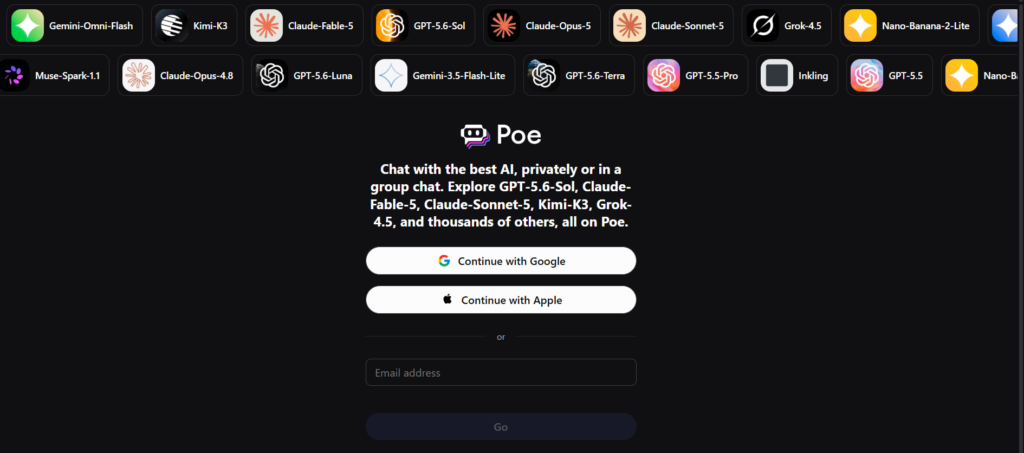
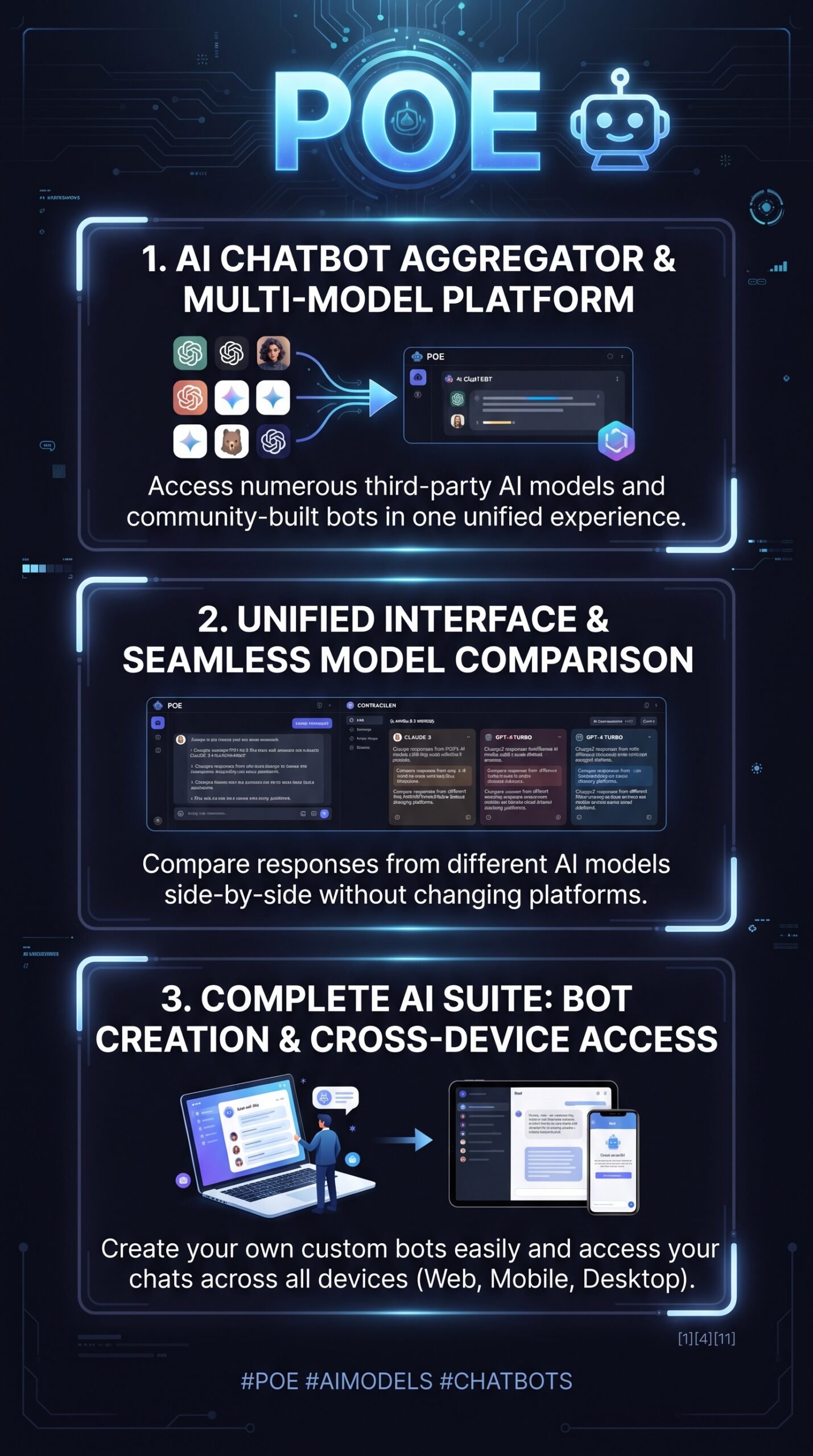
POE’s core feature is access to a wide range of third-party models from one account. Based on the platform’s current model roster, that includes GPT-5.5, GPT-5.6 variants, Claude Sonnet 5, Claude Opus 5, Gemini Flash models, Grok 4.5, and community models like Kimi-K3. You don’t need separate subscriptions to each provider to try them — you pick the model inside POE and send your prompt.
Model Switching and Side-by-Side Comparison
You can switch models mid-conversation or run the same prompt across multiple models to compare outputs. For anyone doing prompt engineering or content research, this is genuinely useful. It removes the friction of copying a prompt, opening a new tab, pasting it again, and comparing results manually.
Custom Bot Creation
POE supports bot creation beyond just chatting. Users can build prompt bots — essentially a model with a set system prompt — or server bots, which use Poe’s API to connect external logic. This turns the platform into a creation layer, not just a consumption layer. Builders can share their bots with the POE community.
How POE Works
The Routing Layer
According to the vendor’s documentation and consistent across reviewed sources, POE acts as a routing and aggregation layer. When you submit a prompt, POE forwards it to the model or bot you’ve selected, then returns the response inside POE’s own conversational UI. You never actually leave the POE interface. The underlying model handles the generation; POE handles everything else.
Compute Points and Access Tiers
Not all models cost the same to run. POE manages this with a compute-point system. More expensive models — frontier models like Claude Opus or GPT-5 variants — consume more points per message. Free users get a daily allowance. Paid subscribers get more points and access to models that aren’t available on the free tier. The practical upshot: your daily experience depends heavily on which models you use and how often.
What the Evidence Shows
What the Vendor Claims
POE positions itself as the easiest way to access and compare the world’s best AI models in one place. Their landing page highlights access to GPT-5.6-Sol, Claude-Fable-5, Claude-Sonnet-5, Grok-4.5, and thousands of community bots. They emphasize private chat, group chat support, and multi-device availability. The pitch is breadth, convenience, and exploration — not depth with any one model.
What Users Report
User sentiment across reviewed sources is generally positive around the core convenience angle. People frequently praise having many models in one place, easy model switching, and the ability to compare outputs without managing multiple subscriptions. The criticism that comes up most often is the usage-cap structure. Reviewers note that access to the latest or most compute-heavy models can feel constrained by point allowances, which frustrates users expecting unlimited high-end access. Some sources also flag ambiguity around exact pricing, which varies depending on region and plan type.
How It Stacks Up Against the Category
Most AI tools reviewed on this site are single-purpose: one model, one workflow, one price. POE is structurally different. It doesn’t compete with ChatGPT or Claude on model quality — it competes on access and variety. For users who already pay for DeepSeek or other individual tools, POE might feel redundant if they’re happy with one assistant. For users who need to compare or switch regularly, POE fills a real gap that no single-model platform does.
POE vs Competitors
POE doesn’t really go head-to-head with ChatGPT or Claude on model quality — it gives you access to both. The more useful comparison is whether POE’s aggregation layer adds enough value over just subscribing directly. Here’s how the platforms stack up on features and availability:
| Feature | POE | ChatGPT | Claude | Perplexity |
|---|---|---|---|---|
| Multi-model access | Yes (many) | OpenAI only | Anthropic only | Partial |
| Model comparison | Yes | No | No | No |
| Custom bot creation | Yes | Yes (GPTs) | No | No |
| Free tier | Yes | Yes | Yes | Yes |
| Community bots | Yes | Yes (GPT Store) | No | No |
If you want a deeper look at an individual AI assistant, our DeepSeek review and Brila AI review cover single-model tools worth comparing.
Pricing
Point System: Each bot consumes points differently based on how advanced or resource-intensive the AI model is.
Add-on Points: If you run out of points, you can purchase additional credit bundles.
You can view and manage current options directly on the Poe Subscription Plans page.
Prices shown in US dollars. Your final price may vary based on regional taxes and currency conversion
| Plan | Monthly price | Annual price | Points |
|---|---|---|---|
| Free | $0 | – | 3 000/day – varies by LLM model |
| Starter / Lite | $4.99 | $59.88 | 10 000/day – access premium models |
| Standard / Premium | $19.99 | $239.88 | 660 0000/month – high limits on GPT‑4/Claude, image/video models |
| Pro / Premium Plus | $49.99 | $599.88 | 1.65 million/month |
| Advanced | $99.99 | $1199.88 | 3.3 million/month |
Pros and Cons
Pros
- Access to a wide range of AI models — including GPT-5, Claude, Gemini, and Grok — from a single account
- Model switching and comparison in one interface saves real time for power users
- Free tier available with no credit card required
- Custom bot creation supports both simple prompt bots and server-side integrations
- Community bot ecosystem extends the platform well beyond standard chat
Cons
- Compute-point limits can make access to frontier models feel restrictive, especially on the free tier
- Pricing information is inconsistent across sources, making it hard to plan costs before signing up
- If you only use one AI model regularly, a direct subscription to that provider is probably simpler and cheaper
Who Should Use POE?
POE works best for users who genuinely need more than one model. Prompt engineers comparing output quality across GPT, Claude, and Gemini will get real value from the switching and comparison features. Researchers and content creators who want to test different assistants on the same brief will save time. Bot builders who want to ship something quickly without setting up their own API infrastructure can use the bot-creation tools to get started fast.
POE is less ideal for users who’ve already settled on one AI and use it daily. If you’re a committed ChatGPT or Claude user with no interest in switching, the aggregation layer adds cost and complexity without much benefit. It’s also worth noting that power users who push frontier models hard every day may find point limits frustrating.
POE Main Facts
Frequently Asked Questions
Is POE free to use?
Yes, POE has a free tier that doesn’t require a credit card. Free users get daily usage allowances, though access to the most compute-intensive models may be limited or unavailable without a paid plan.
What AI models does POE support?
Based on the current platform, POE includes access to models from OpenAI (GPT-5 variants), Anthropic (Claude Sonnet and Opus), Google (Gemini Flash), xAI (Grok), and community-built bots. The model roster changes as new models are added.
Can you build your own bots on POE?
Yes. POE supports prompt bots — models configured with a custom system prompt — and server bots that connect to external logic via Poe’s API. Bots can be shared with the community.
How is POE different from ChatGPT?
ChatGPT is a single-model product built on OpenAI’s GPT models. POE is a multi-model aggregator that includes ChatGPT-equivalent models alongside Claude, Gemini, Grok, and others. POE’s value is breadth and comparison; ChatGPT’s value is depth and native OpenAI integration.
Final Verdict
POE is a well-designed platform that solves a real problem — AI fragmentation — in a practical way. For anyone who regularly uses more than one AI model, it reduces friction and saves time. The free tier is a genuine entry point, and the bot-creation features push it beyond basic chat aggregation.
The weaknesses are real but manageable. Point-based limits on premium models aren’t a dealbreaker, but they do mean you should check pricing carefully before assuming unlimited frontier access. And if you only ever use one AI, POE probably isn’t worth the added layer.
Overall, POE earns a recommendation for multi-model users, prompt engineers, and anyone who wants to explore the AI landscape without managing five separate subscriptions. Just go in with clear expectations about usage limits.
Review Methodology
This review is based on analysis of the vendor’s documentation, pricing pages, and feature set, combined with user reports gathered from product review writeups, community discussions, and third-party AI tool comparisons. No hands-on testing was conducted. All claims are grounded in the research data cited above.