
Disclosure: Some of the links on Daily Digital Reviews are affiliate links. This means that if you click on a link and make a purchase, we may earn a small commission — at no extra cost to you.
Is Perplexity Actually Better Than Just Googling?
Perplexity, the AI-powered answer engine, has been making noise as a serious alternative to traditional search — and I wanted to find out if that reputation holds up. The pitch is simple: instead of giving you ten blue links, it reads the web for you and hands back a single, cited answer. That sounds useful. But useful tools and overhyped tools can look identical from the outside, so I dug into the feature set, user reports, and pricing to give you a straight read.
Quick Verdict: Perplexity is one of the strongest tools available for fast, citation-backed research. It genuinely reduces the friction of going from question to answer, and the free tier is usable. The main caveat: answer quality still depends on the quality of the pages it retrieves, so it works best as a research starting point, not a final authority.
Overall Rating: 4.3 / 5 ⭐
Feature depth: 4/5 · Ease of use: 4.5/5 · Pricing value: 4/5 · Trust signals: 4.5/5
What Is Perplexity?
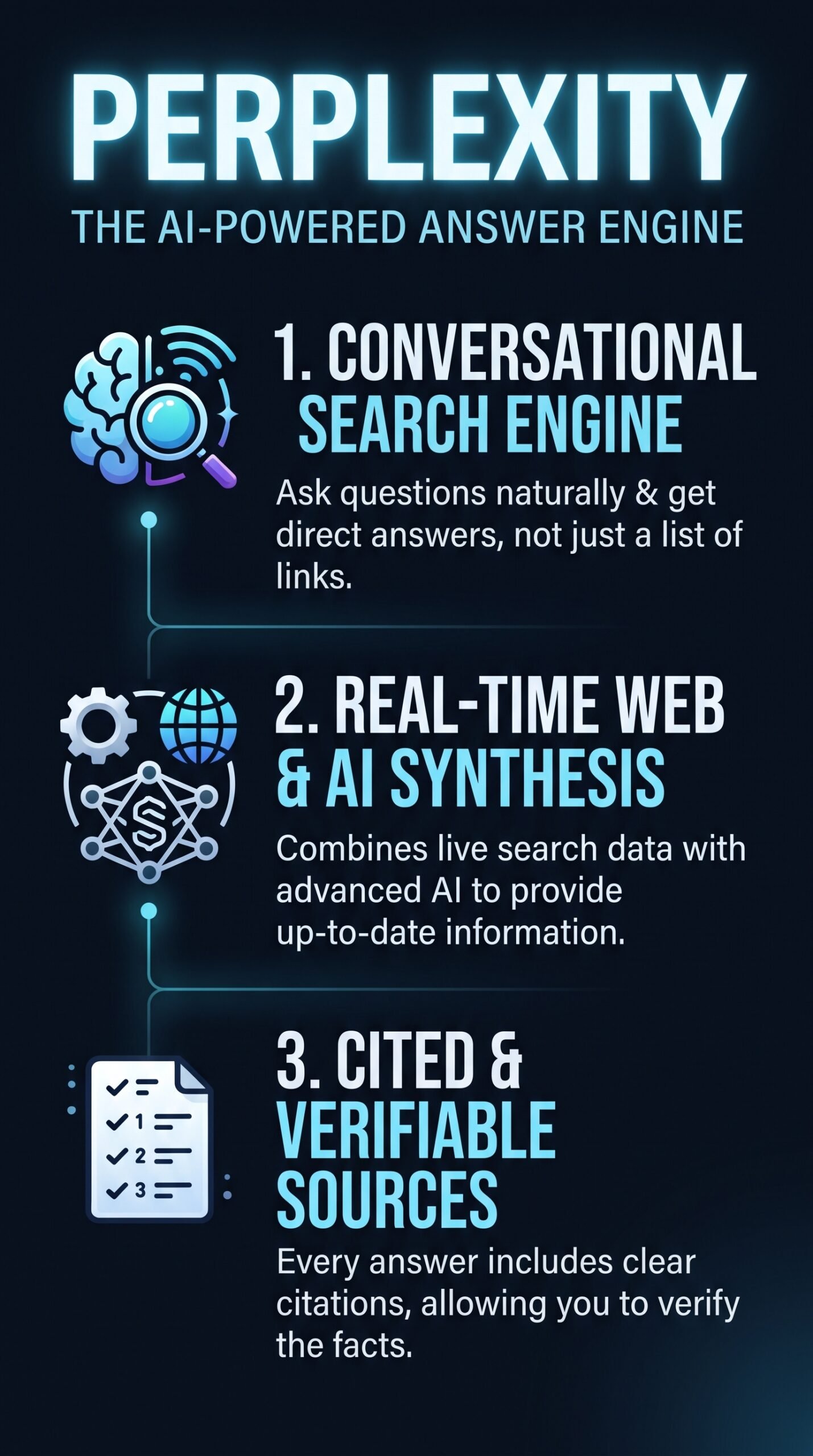
Perplexity is an AI-powered answer engine that sits somewhere between a search engine and a chatbot. You type a question, and instead of returning a list of links, it retrieves live web sources, reads them, and synthesizes a direct answer — with citations attached so you can check the original material yourself.
It’s built for people who need fast synthesis of current information: students, journalists, analysts, and anyone doing exploratory research. The company describes it as a tool for exploring topics, summarizing content, and going deeper on complex questions while showing where the information comes from. It’s not a writing assistant or a coding tool in the way that tools like Claude or Gemini are — its core identity is research-oriented conversational search.
Key Features
Real-Time Web Search With Citations
This is the core feature. Perplexity doesn’t answer from static training data alone — it retrieves live web content and attaches inline citations to its responses. That means you can trace any claim back to the source page. For research tasks where accuracy matters, that’s a meaningful difference from a standard chatbot.
Conversational Follow-Up and Research Summaries
You can ask follow-up questions in the same thread, and the tool keeps context. It’s designed for multi-step research rather than one-off lookups. If you’re trying to understand a topic from multiple angles, the conversational format lets you go deeper without starting from scratch each time.
Multi-Model and Deeper Research Workflows
According to the product’s positioning, higher-tier plans unlock access to different underlying models and more thorough research modes. This lets power users choose between speed and depth depending on the task.
Agentic Features
Newer product tiers include agentic capabilities such as a shopping assistant and more advanced browser-style workflows. These push Perplexity beyond simple Q&A into territory where it can help with multi-step tasks — though these features are tied to paid plans.
How Perplexity Works
The Retrieval-Augmented Approach
When you submit a query, Perplexity retrieves relevant pages from the live web, ranks them, reads them, and then uses large language models to synthesize the information into a single response. Citations are attached so every claim points back to a source. This retrieval-augmented architecture is what separates it from a pure chatbot — the model isn’t just pulling from what it learned during training, it’s reading current web content to build the answer.
The User Experience
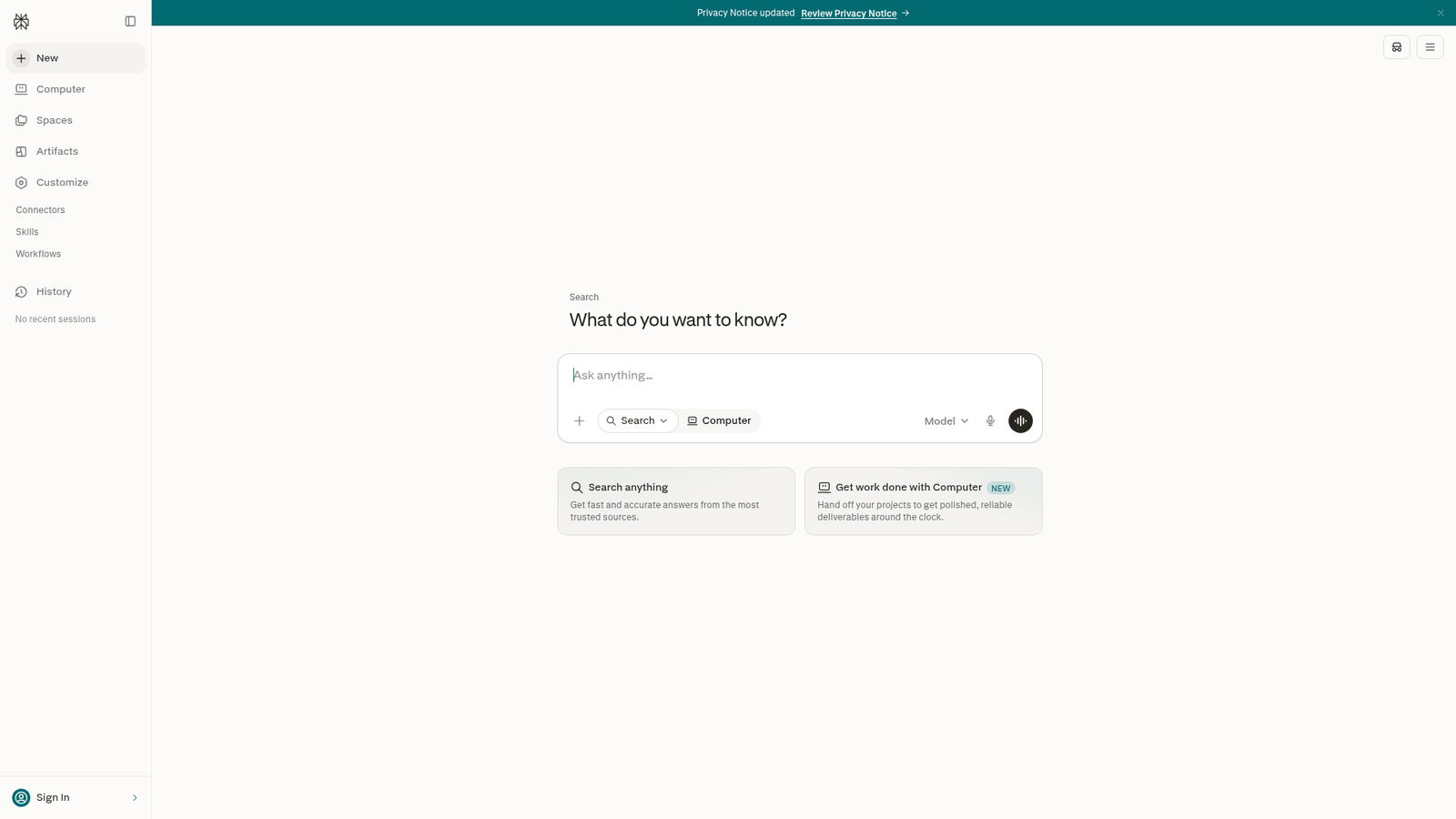
The interface is clean and minimal. You type a question, the answer appears quickly with numbered citations, and you can click any citation to see the source. If you want to go deeper, you ask a follow-up. There’s no complicated setup. The learning curve, based on user reports, is essentially flat — most people get value from it within the first session.
What the Evidence Shows
What the Vendor Claims
Perplexity positions itself as a fast, trustworthy research tool that makes it easier to explore topics and verify information. They emphasize that citations are central to the product — not an afterthought. They also describe an expanding set of agentic features for users who need more than basic Q&A.
What Users Report
User sentiment is broadly positive. Reviews consistently highlight speed, ease of use, and the ability to surface sourced answers quickly. The tool is frequently described as genuinely useful for quick fact-finding and topic exploration. The recurring criticism — and it’s a fair one — is that answer quality is only as good as the pages it retrieves. If a retrieved source is noisy, unreliable, or out of date, the synthesized answer can reflect that. Users who understand this limitation tend to rate it highly; users who treat every answer as authoritative run into trouble.
How It Stacks Up Against the Category
Compared to other AI search tools, Perplexity is notable for being built around citations from the ground up rather than adding conversational features onto an existing search product. That architectural choice shows in the experience. Tools like DeepSeek are strong on reasoning but aren’t primarily search engines. General chatbots don’t show their sources reliably. Perplexity occupies a distinct niche: cited, real-time, conversational research.
Perplexity vs Competitors
| Feature | Perplexity | Google Search | Microsoft Copilot |
|---|---|---|---|
| Real-time web retrieval | Yes | Yes | Yes |
| Inline citations on answers | Yes (core feature) | Partial (AI Overviews) | Partial |
| Conversational follow-up | Yes | Limited | Yes |
| Agentic / advanced features | Yes (paid tiers) | No | Partial |
| Free tier available | Yes | Yes | Yes |
| Paid plan starting price | ~$20/month | Free / Google One bundles | Microsoft 365 bundle |
Google Search is still the default for most people and handles broad discovery well, but it’s link-first, not answer-first. Microsoft Copilot is built into the Microsoft ecosystem, which makes it more convenient if you’re already using Edge or Office, but citations feel less central to the experience. You.com and Brave Search also offer AI-assisted retrieval with privacy-focused angles, and Arc Search takes a mobile-first approach — but none of them have made cited, conversational research their primary design goal the way Perplexity has.
Pricing
Perplexity pricing has a free tier that includes core answer-engine functionality with citation-backed search — enough to evaluate whether the product works for you. The Pro plan runs around $20 per month or about $200 per year, based on publicly reported pricing. There are also higher-tier plans such as Max and Enterprise for power users who need advanced agentic features.
| Plan | Monthly price | Key features / limits |
|---|---|---|
| Standard | $0 | Unlimited basic searches, limited “Pro Searches” (3-5 per day) |
| Perplexity Pro | $20 | GPT‑5, Claude Opus, extended Pro Search, image/video generation, Comet browser |
| Education Pro | $10 (with student/educator verification) | Same as Pro,+ study‑mode features and higher citation limits |
| Perplexity Max | $200 | Highest models, very high Pro Search/Labs/Research limits |
Pros and Cons
Pros
- Fast, real-time answers backed by live web retrieval
- Inline citations let you verify every claim at the source
- Simple, intuitive interface with almost no learning curve
- Strong free tier makes it easy to try before paying
- Conversational follow-up supports multi-step research workflows
Cons
- Answer quality depends on the quality of retrieved sources — noisy sources produce noisy answers
- Advanced features and deeper research modes are locked behind paid plans
Who Should Use Perplexity?
Perplexity works best for people who do a lot of research and find the traditional search-scan-click-read workflow slow and inefficient. Students writing papers, journalists checking background information, analysts exploring an unfamiliar topic, and solopreneurs trying to get up to speed on a new market are all strong fits. If you value being able to see where an answer came from, the citation-first design is genuinely useful.
It’s less suited to people who need domain-specific databases, formal academic sourcing, or work in fields where every claim needs traceable, peer-reviewed backing. It’s also probably redundant if you’re already deep into the Microsoft ecosystem and happy with Copilot, or if you need a general-purpose AI writing assistant — tools like Claude are better for that job. Use Perplexity as a research starting point, not the last word.
PERPLEXITY Main Facts
Frequently Asked Questions
Is Perplexity free to use?
Yes. There’s a free tier with core answer-engine functionality and citation-backed search. The paid Pro plan, at around $20 per month, unlocks more advanced features including deeper research modes and agentic capabilities.
How is Perplexity different from ChatGPT?
Perplexity is built around real-time web retrieval and inline citations. It’s designed for research, not open-ended conversation or content creation. ChatGPT and similar general-purpose chatbots primarily draw from training data and don’t make citations central to the experience in the same way.
Can I trust the answers Perplexity gives?
The citations mean you can verify claims, which is more than most tools offer. But accuracy still depends on the quality of the pages retrieved. Treat answers as a fast starting point and spot-check the cited sources for anything consequential.
Does Perplexity work for current events?
Yes. Because it retrieves live web content rather than relying solely on static training data, it can surface recent information. This is one of its clearest advantages over chatbots with knowledge cutoffs.
Final Verdict
Perplexity is a genuinely useful tool that delivers on its core promise: fast, cited, conversational research. For solopreneurs, students, and anyone who spends time doing exploratory research online, it’s worth trying — the free tier makes that a low-risk experiment. The $20/month Pro plan is reasonable if you use it regularly and want access to deeper research modes.
The honest limitation is the same one that applies to all AI search tools: the model is only as good as what it retrieves. Citations help, but they don’t replace judgment. Go in with clear expectations — use it to explore and synthesize, not to produce final authoritative answers — and Perplexity is one of the strongest tools in this category.
Review Methodology
This review is based on analysis of the vendor’s documentation, pricing pages, and feature set, combined with user reports and coverage gathered from public product reviews, technology publications, and community discussion.